Accusations filled the room almost immediately after our daughter was born.
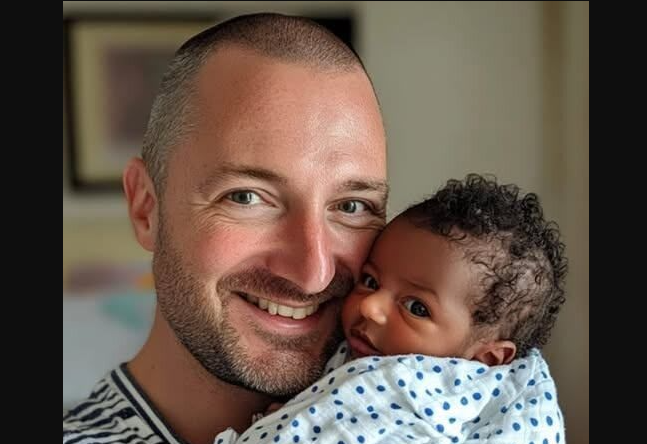
Both my wife and I are white. We had spent years preparing ourselves for parenthood, imagining what our child might look like, dreaming about the moment we would finally hold her. When our baby arrived with dark skin and tight, curly black hair, the atmosphere outside the delivery room shifted in an instant. What should have been joy turned into shock. Murmurs spread quickly. Looks were exchanged. Doubt settled in the air before anyone spoke a full sentence.
That day, which followed years of hope, medical appointments, and quiet disappointment, suddenly felt fragile and uncertain. Instead of celebration, there was tension. Instead of laughter, there were questions no one wanted to ask out loud.
I was beside my wife in the delivery room, holding her hand as she pushed through exhaustion and pain. When our daughter was born, the nurse moved gently to place her in my wife’s arms. Stephanie screamed.
“No, that’s not my baby.”
The words cut through the room, sharp and raw. I looked from Stephanie to the baby, my heart racing. The child was beautiful, calm, and very real. My mind struggled to process what my eyes were seeing, and confusion spilled out of me.
“What the hell, Stephanie?”
The umbilical cord was still attached. There was no possibility of a switch. This child had come from my wife’s body moments earlier. Stephanie’s face crumpled as tears streamed down her cheeks.
“I swear to you, Brent,” she said through sobs. “I have never been with another man. Please, you have to believe me.”
Her voice was desperate, pleading for trust in a moment when trust felt shaken. Outside the room, my family’s voices grew louder. Accusations surfaced openly. Judgments followed. The sound of doubt pressed against the walls.
I stepped into the hallway, trying to breathe. My mother found me there. Her expression was firm, unyielding.
“Brent, you cannot stay with her,” she said. “Don’t be blind to what this means.”
Her words echoed what others were thinking. Part of me wanted to defend my wife without hesitation. Another part struggled under the weight of confusion. Yet when I looked again at our daughter, something inside me paused. Her eyes mirrored mine. Her smile formed the same dimples that had been passed down through my family for generations.
I needed certainty. Not to punish Stephanie, but to protect the truth. I went to the hospital’s genetics department. They explained the process calmly: a cheek swab, a blood sample, standard procedures. For me, it felt heavy. It felt like a test of loyalty, even though it was a search for facts.
The days that followed were long. Stephanie barely spoke, worn down by exhaustion and fear. I watched her hold our daughter, whispering to her, loving her without hesitation. That sight stayed with me.
When the results finally arrived, the doctor sat with me and spoke carefully.
She was mine. My biological daughter.
The doctor explained how recessive genes can remain hidden for generations before appearing again. It was uncommon, yet completely possible. Somewhere in our shared family histories, traits had existed quietly, waiting for the right combination to surface.
Relief washed over me, followed closely by shame. I had questioned the woman who trusted me most during the most vulnerable moment of her life.
I walked back into the hospital room and placed the results in Stephanie’s hands. She looked at the paper, then at me, her eyes searching for what my words would bring.
“I’m sorry I doubted you,” I said softly.
Her shoulders relaxed as tears returned, this time mixed with relief. She took my hand.
“We’re okay,” she said. “That’s all that matters.”
As she drifted into sleep, worn down by labor and the emotional weight of the day, I held our daughter. She fit perfectly against my chest. Her breathing was steady. Her presence felt grounding.
She was beautiful. She was whole. She was ours.
In that moment, I understood how easily fear can replace trust, and how important it is to pause before allowing doubt to define love. Our family began not in certainty, but in truth—and that truth held us together.