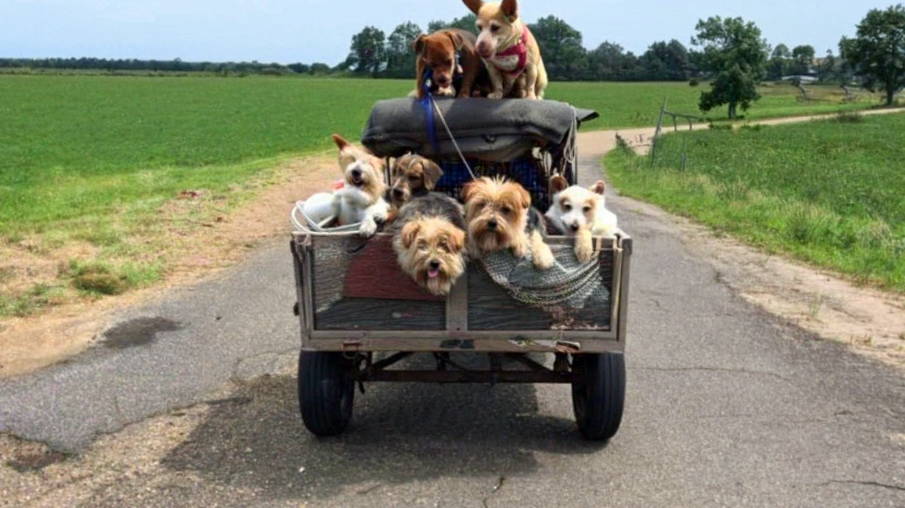
She pulled over fast, gravel kicking up under her tires.
I’d seen that look before—tight jaw, sunglasses on even though the sky was overcast. That “I’ve had enough of this nonsense” energy. Most folks drove past. A few tossed out insults. But when they actually stopped, it usually meant trouble.
She stepped out in a crisp blouse and clean shoes that didn’t belong near a roadside ditch.
“Excuse me,” she snapped, pointing to the cart. “Are those all yours?”
I didn’t say anything at first. Reached back to stroke Tilly’s ears. She was perched on top like she owned the thing. Her back leg was still healing from the last storm.
“I’m asking because it’s not safe,” the woman continued. “They’re out in the heat, there’s no shade, and one of them is limping. I’m calling someone if you don’t do something.”
Still calm, I said, “They’re not mine. Not really. I found ’em where other people left ’em.”
She scoffed. “You’re not even taking care of yourself. How can you care for six dogs?”
I looked down at the food bag I’d split four ways yesterday. At the water bowl I’d filled with rain last night. At the patched blanket I’d sewn by hand so Bear wouldn’t sleep cold.
Then I stood up and walked to the back of the cart.
“I didn’t plan this,” I said. “But they keep showing up.”
And then I pulled out the journal I kept under the crate—the one with every name, every vet visit, every rescue date.
I handed it to her.
She opened it.
Read the first page.
And then she looked at me like she’d recognized something.
Her lips parted, and she blinked a few times. “Wait… you’re John?”
I felt a cold breeze go down my spine. “Depends on which John you mean.”
She held the journal up like it was evidence in a courtroom. “John Hastings. My brother used to volunteer with a man named John at the Oakridge Shelter. He always talked about how you did more with nothing than some people did with full backing.”
I squinted at her. “You’re Thomas’ sister?”
She nodded, and suddenly her tone dropped. All the edge fell away.
“I’m Nora,” she said, voice softer now. “I didn’t realize… he told me you disappeared after the shelter closed.”
“Didn’t disappear,” I said. “Stopped being welcome in places that cared more about rules than beings.”
She knelt down next to the cart, reaching out her hand slowly like she wasn’t sure if she should pet Tilly. Tilly gave a little wag and licked her palm.
“I thought you were some guy hoarding strays,” she admitted.
“That’s what most folks think,” I said. “Until they look a little closer.”
Nora sat back on her heels and looked at the dogs again. Six of them, all different sizes. Some missing fur, some with cloudy eyes, but every one of them alert, watching her like they were waiting to see if she was friend or foe.
“I want to help,” she said.
“You already helped by not yelling,” I said.
“No,” she insisted. “I mean really help.”
That’s how it started.
Nora came back the next day, and the day after that. She brought more than sympathy—she brought meds, food, and a collapsible tent that made shade for the pups.
She didn’t try to change me. Didn’t push me to go to a shelter or sign up for some program. She… showed up.
One afternoon, about two weeks in, she brought someone else. A tall guy in scrubs with a vet badge clipped to his collar.
“This is Raj,” she said. “He owes me a few favors.”
Raj did more than patch Tilly up properly. He checked all the dogs, gave us flea meds, and even offered to neuter the younger ones at a clinic he worked with off the books.
“They’ve been through enough,” he said, after kneeling beside Bear for a full ten minutes. “It’s the least we can do.”
I didn’t cry, but I felt the lump rise. Not for me—but for them. For every dog that had been overlooked until now.
A month passed like that.
We made a routine. Mornings were for walking and stretching legs. Midday was rest, shade, and a little training. Evenings, Nora would bring news—shelters with vacancies, families looking to adopt, local rescues who might be open to working with a guy like me.
We found homes for two—Peanut and Rosie. The little ones always went first.
I missed them more than I expected.
One night, as I was folding up the tarp, Nora stayed back.
She sat cross-legged near the cart and said, “You ever think about doing this officially?”
“Doing what?”
“This—rescuing. Caring. Organizing. You already are, but with a place. A setup. Perhaps even volunteers.”
I laughed a little. “You think someone’s going to hand a homeless man a rescue license?”
“Not a license,” she said. “But perhaps a barn. My family’s got one outside of town. Not being used for anything but dust and old hay. And I’ve got some friends who wouldn’t mind helping with repairs.”
I stared at her. “Why?”
She looked straight at me. “Because I think this is exactly what my brother would’ve done, if he’d lived long enough.”
I looked down, heart skipping. I hadn’t thought about Thomas in years.
He died young—too young. Cancer didn’t care how kind you were. But the boy had more heart than most adults I’d met.
“You sure?” I asked.
She nodded.
Two weeks later, we rolled the cart up the gravel path to the old barn.
It was worn down, and the roof had holes the size of dinner plates, but it was ours.
Mine. Theirs.
People came—some Nora knew, some she’d posted online to call in. They brought wood, nails, old kennels. One guy donated insulation and another woman brought food in bulk.
We cleaned, we painted, we patched the roof with tarps until proper shingles could be bought.
Someone even built a fenced enclosure.
And all the while, the dogs watched, tails wagging.
I slept in a corner near them, never far.
It felt like home.
We called it Second Tails.
Nora printed flyers. Made a website. She even convinced a local reporter to write a piece about “the man who never stopped rescuing.”
It caught on.
Donations trickled in. Volunteers started showing up on weekends. One girl named Meera came every Thursday to walk the seniors. Another guy, Miguel, fixed anything that broke.
And slowly, my story spread.
Not the “homeless man with dogs” story. The real one.
The story of a guy who once worked at a shelter, lost everything when funding ran out, and still didn’t stop caring.
The man who slept with animals to keep them warm and recorded every name so no soul went forgotten.
One morning, Nora came in smiling. “Guess what?”
I grinned. “We finally hit a thousand followers?”
“Better. Someone wants to meet you. Big-time donor.”
I raised an eyebrow. “I don’t do suits and meetings.”
She laughed. “She’s not like that. She runs a foundation for rural rescue programs. Loves stories with grit.”
So I agreed.
When the woman came, she didn’t wear pearls or heels. Boots, jeans, and a ponytail.
Her name was Celine, and she walked the barn with me in silence, letting the dogs sniff her hands.
“You’re doing something right here,” she said.
I shrugged. “Trying to keep up.”
She smiled. “What if I told you I could help this place grow? More fencing, more kennels. A training area. Perhaps even a proper medical room.”
I didn’t answer right away.
Then she added, “And I’d make sure it always stays in your name.”
That got me.
I agreed.
Months passed, and Second Tails bloomed.
More dogs came in, more left in better shape.
Some had stories worse than mine—abandoned in crates, left behind in moves, tied to fences in storms.
We took them all.
One day, a boy came in with his grandma. He was quiet, shy, barely said a word. But then Bear waddled over and put his head in the boy’s lap.
The kid lit up.
They adopted Bear that afternoon.
I cried that night.
Not because Bear was gone. But because he’d found exactly who needed him.
Then came the twist I never saw coming.
One of the new volunteers brought a faded photo to show me. “You know this woman?” he asked.
I looked.
It was my mother.
My breath caught.
“She passed three years ago,” the guy said. “But before that, she ran a small rescue out of her backyard. I was one of the teens she mentored.”
I broke down right there.
It felt like the full circle was complete.
That perhaps, in some strange way, my mother’s kindness hadn’t passed through me—it had multiplied.
Today, Second Tails is still small. But it’s strong.
I’ve got a real bed now. A shower, too. But I still sleep near the dogs most nights.
Some habits are worth keeping.
Nora visits all the time. She even adopted Tilly. Says she earned the title of “office dog.”
I smile every time I see them together.
Because none of this would’ve happened without one woman who decided to stop and ask questions instead of driving past.
And perhaps that’s the point.
Sometimes, all it takes is one person believing in you to change everything.
So the next time you see someone you don’t understand—look closer.
They might surprise you.
If this story moved you, give it a like, share it with someone who needs hope today, and tell us: when was the last time you looked closer?