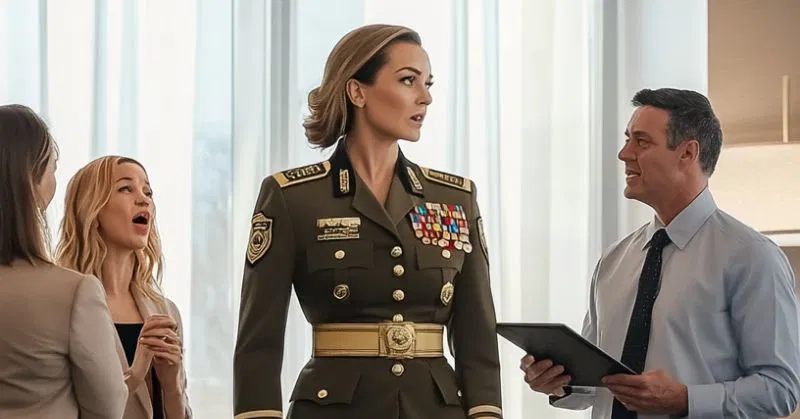
My name is Cassandra Rhys. I’m 30 years old, a Colonel in the United States Army, and tomorrow morning, I’ll sit across from my father and brother during a crucial defense contract review. What they don’t know is that I’m the Pentagon liaison with final sign-off authority for the entire project.
It’s been five years since I walked out of this house and didn’t look back.
I was tired of being the family’s letdown—the daughter who “threw away” her future by joining the military instead of heading to business school. My father once scoffed that the army was for people with no true ambitions. That was the last honest conversation we ever had.
Tonight, I’m back for dinner. My mother will beam over Ethan’s promotion, my dad will nod approvingly, and someone will ask me if I’m “still deployed somewhere.” I won’t argue. I won’t correct them. Because tomorrow, when their CEO refers to me as “Colonel Rhys” in a room full of executives, that moment of realization will say more than I ever could. Let them have tonight. Tomorrow will rewrite everything.
The driveway seemed tighter than I remembered. My rental SUV felt stark, too deliberate next to my mother’s dented crossover. I shut off the ignition and sat in stillness. My hands were steady—what we call operational calm—but my stomach twisted the way it always did before an assignment. The porch light cast a warm hue over the worn welcome mat. Nothing had changed, especially not the mixed feeling of being invisible and scrutinized the moment I stepped inside.
I rang the bell. “Cassandra!” my mom’s voice floated from the kitchen. “It’s open!”
I eased the door open and stepped in. The air still held that familiar floral fragrance. The wall on the right was a gallery of framed milestones: Ethan’s graduation, his wedding, his children. No photos of me in uniform. Not even the commissioning portrait I mailed them years ago.
“Dinner’s almost ready,” my mom said without glancing up. “Ethan and Tara are on their way. He just secured another leadership role—can you believe it?”
I nodded, offering a neutral smile. “That’s good news. You should be proud.”
As expected, Ethan and Tara arrived precisely on schedule. He wore one of those blazers that says, “I’m busy, but approachable.”
“Hey, Cass,” he said with a quick hug, already scanning the room for our father. “It’s been a while.”
“Five years,” I replied. He blinked, unsure whether I was joking. I wasn’t.
We had roast chicken and mashed potatoes. Ethan led the table conversation, discussing team mergers and strategic growth. My dad appeared deeply impressed.
“And how about you?” Mom turned to me, her expression pleasant but distant. “Still moving around with the army?”
“Something like that.”
“Still a captain, right?” my father asked, not even glancing up.
“More or less.”
“It must be challenging,” Ethan chimed in, “always out there with no comprehensive control. Only reacting and executing.”
I stayed silent. Upstairs, my uniform waited neatly in my suitcase, its silver eagle insignia catching the light like truth waiting to be revealed. Tomorrow, they’d understand precisely how much strategy I controlled. For now, I let them talk. It would be the last night they ever talked over me.
After dinner, I spent the evening in my old room. The space was frozen in time, filled with traces of the daughter they once imagined I’d become: medals from school, varsity plaques, college admission letters. But nothing after ROTC. Nothing from my deployments. No framed awards for my cybersecurity work. No recognition of my promotion to Lieutenant Colonel, and certainly nothing about the rare achievement of making full Colonel by 30. In this home, that chapter of my life didn’t exist.
Downstairs, I heard laughter. Ethan’s booming confidence. The atmosphere of a family rallying around its designated star. The irony was palpable. He’d just been promoted to lead the integration team for the very military tech project that I now supervised. He had no idea. None of them did.
At 0900 sharp the next morning, I would step into Westbridge Innovations, dressed in full uniform, to lead the review as the Pentagon’s primary liaison for Project Vanguard—the same program Ethan boasted about over dinner.
I unzipped my bag and pulled out the uniform: crisp midnight blue, medals aligned with precision, insignia gleaming. My hands moved methodically. Tomorrow wasn’t about proving anyone wrong. It was about showing up fully, with authority, in a language that couldn’t be brushed off.
By 8:45 AM, I was parked in the reserved DoD slot outside Westbridge. I stepped out in full dress, adjusting my collar. People turned to look as I passed through security.
“Good morning, Colonel,” the security guard said, scanning my credentials with practiced precision. The respect in his voice was unfamiliar—at least compared to what I’d heard at home.
I took the elevator to the executive floor. As the doors opened, the first person I saw was Ethan, tapping through a presentation on his tablet. He looked up, startled. “Cass? Why are you… what is that?”
I walked past him. “Good morning, Mr. Rhys. I’m here for the review.”
A few feet away, my father’s voice echoed. He came into view and stopped cold. “Cassandra? What’s going on? Why are you in uniform?” His eyes darted to those around him, reading their reactions. Slowly, it began to dawn on him.
Before I could respond, a woman with sharp white hair turned the corner. Lorraine Hart, Westbridge’s CEO, halted mid-step. Then she smiled broadly. “Colonel Rhys. I didn’t know you’d be joining us in person. What a pleasure.”
I shook her hand. “I was nearby and thought it would be helpful to attend directly.”
“Absolutely,” Lorraine said, turning to the group. “Everyone, in case you haven’t met her, this is Colonel Cassandra Rhys, Pentagon liaison for Project Vanguard. She has final approval authority over all defense integrations on this initiative.”
You could feel the energy shift. The hallway fell into silence. I didn’t look back at my father or brother. I didn’t need to. I could feel their shock without seeing it.
In the conference room, a placard with my name waited beside Lorraine’s. I sat, reviewed my notes, and prepared. My father and Ethan entered last, visibly unsettled.
The meeting began at 0900 on the dot. Lorraine opened, then passed it to me. I stood and walked through our progress benchmarks, outlined technical requirements, and asked direct questions. I scanned the room deliberately, looking every speaker in the eye.
Then it was Ethan’s turn. He stood slowly, clutching his notes. “As lead for systems integration, I’ve developed a revised deployment schedule for Phase Two,” he said, stumbling slightly. “I believe it aligns with current expectations.”
I waited a beat. “Mr. Rhys,” I said, my voice even, “could you explain how your model accommodates the low-latency parameters in our last DoD memorandum?”
He froze. “I… I’ll need to revisit that.”
“Please do. It’s critical to meet those standards. I’ll expect a revised plan by close of business Thursday.”
He nodded, jaw tight. “Yes, ma’am.”
The meeting continued.
After it ended, a few stayed behind, casting new looks—ones filled with understanding. My rank was no longer an abstract title. It was real.
My father lingered near the hallway. “Cassandra,” he said softly when we were alone, “we need to talk.”
I nodded. “Your office?”
My mother was already seated when we walked in, looking nervous. Ethan stood by the window, arms crossed. All three of them—my lifelong jury—now facing something they couldn’t rationalize away.
“You’ve been a Colonel for how long?” my father finally asked.
“Six months.”
“And you didn’t think to mention it?”
“I did,” I said. “I sent invitations. I emailed. I left messages. I even sent press clippings. No one ever replied.”
My mother jumped in. “We didn’t realize how important it was. ‘Colonel’ sounded serious, but we didn’t really… get it.”
“Why didn’t you tell us what it meant?”
“Because I stopped needing to justify myself,” I said. “Every call turned into a business update about Ethan. You only asked about me to suggest I come home.”
“We thought you were stuck,” Ethan said. “Moving from place to place with no direction.”
I looked at him. “Last night, you joked that people in the military simply carry out instructions.”
He shifted. “I didn’t know what you were doing.”
“You never asked,” I replied.
My father exhaled. “You’ve built something none of us understand. That’s our fault. We assumed we knew best. We didn’t.” He held out his hand. “Colonel Rhys,” he said with genuine humility, “I owe you an apology.”
I shook it. His grip was firm. No resentment. Only resolution. “Apology accepted.”
My mother stood. “We want to start fresh, if you’re willing.”
“One step at a time,” I said. And for the first time, I meant it.
Six months later, we had dinner at my D.C. apartment. My dad brought a framed article spotlighting Project Vanguard—with my picture front and center. “Thought you’d like this,” he said. “It’s been on my wall for a while.”
My mom followed with homemade pie. “Still your favorite, right?”
Ethan and Tara came last, carrying wine and cautious smiles. Later, Ethan pulled me aside. “I implemented that architecture shift you suggested,” he said. “It works better than my original plan.”
“Did you tell your team where it came from?”
He smirked. “Eventually.”
I smiled. “As long as it’s working.”
Across the room, I saw my dad pause at my medals. “This one,” he pointed to the Cyber Defense citation, “I read about it. Didn’t know you led it.”
“I did.”
He nodded. Not a dramatic gesture. Recognition.
Later, over pie, he lifted his glass. “To Colonel Cassandra Rhys,” he said. “Who taught us that success isn’t about following the expected route—but about carving your own.”
We toasted quietly. Around that table, for the first time, I felt something real: respect. Not as a daughter, not as a sister, but as someone who had become undeniable.
And in that moment, I realized I never needed their validation to be complete. That day at Westbridge wasn’t revenge—it was clarity. I didn’t have to explain who I was. My presence said it all. And if they had never seen it, I still would’ve kept going.
Because the most powerful statement isn’t what you say. It’s who you become when no one’s watching.