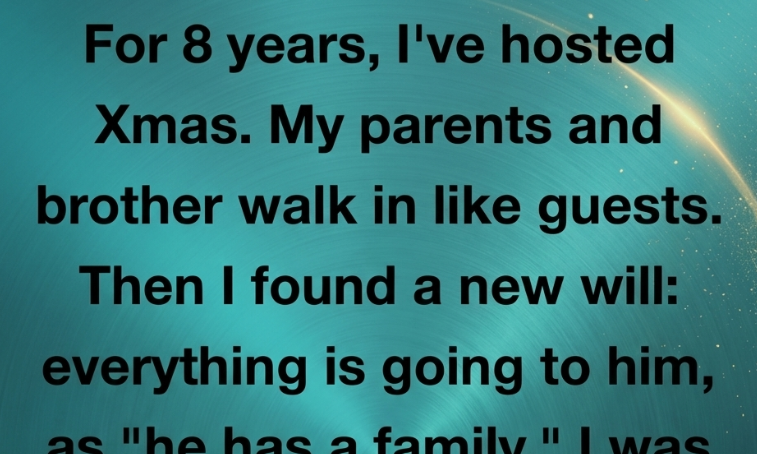
For eight consecutive years, Christmas flowed through my home as if it were an extension of my own body. The same front door welcomed everyone. The same boxes of decorations came down from the shelves. The same rhythm repeated itself without discussion.
I planned the meals, coordinated schedules, cooked for days, cleaned before and after, and absorbed every detail that made the holiday function. Over time, no one asked whether I would host. They arrived with confidence, coats in hand, settling in as if this arrangement had always existed by design. I told myself that reliability equaled value, that consistency earned respect. It took far longer than I expected to recognize how flawed that belief had become.
The moment that shifted everything did not arrive in December. It came quietly in the spring while I was sitting at my parents’ dining table, helping them organize paperwork following a minor health concern. The task felt ordinary, almost routine.
Then I opened a folder labeled “Final.” Inside was their will. I read it without anticipation, assuming it reflected shared intentions. Page by page, it became clear that every major asset—the house, the savings, treasured family items—was designated for my brother. At the bottom, a single sentence explained the decision: “Because he has a family.” In that brief line, years of effort, presence, and emotional labor disappeared. I said nothing in that moment. I finished sorting papers, smiled, and drove home carrying a realization that settled slowly and deeply.
As the year moved toward December again, my approach changed. I did not begin planning menus or setting reminders. Instead, I opened a spreadsheet. I listed every tangible cost associated with hosting Christmas over eight years. Groceries. Utilities. Decorations. Replacements for broken items. Vacation days taken to prepare and recover. I avoided emotions and focused only on numbers that could be verified. When the total appeared on the screen, it told a story I had never allowed myself to see clearly. I saved the file under a simple title: “Christmas Hosting Costs.” I emailed it to my parents and my brother without commentary. No explanation followed. The document stood on its own.
Responses came quickly. Shock. Frustration. Claims that I was being transactional. Assertions that family contributions should not be measured. I did not engage. I did not justify. Silence carried the message more effectively than defense ever had. The spreadsheet remained unchanged, offering no accusations, only facts.
The next morning, my mother arrived at my door holding an envelope. Inside was a revised will, now divided evenly. Alongside it was a letter written in careful handwriting. She acknowledged that my consistency had been mistaken for unlimited capacity. She shared that my father, after reviewing the document, recognized how much responsibility I had carried without recognition. The change did not erase past pain, yet it shifted something important. It acknowledged reality.
That Christmas unfolded in a different house. My brother hosted. The meal was imperfect. Timelines ran late. Dishes piled up. I arrived with a pie, took a seat, and participated without managing. I left when I felt ready. The experience felt unfamiliar, though grounding. Our family did not transform overnight. Patterns do not dissolve that quickly. Fairness, though, entered the room.
Through this process, I learned something essential. Boundaries do not punish others. They protect clarity. Invisible work often remains unseen until it is documented. Accountability does not require anger. Sometimes it requires structure. Love can exist alongside limits. Recognition can follow transparency.
Christmas no longer runs through me. It meets me where I am willing to stand. That change reshaped more than a holiday. It reshaped how I value my time, my energy, and my role within my family.