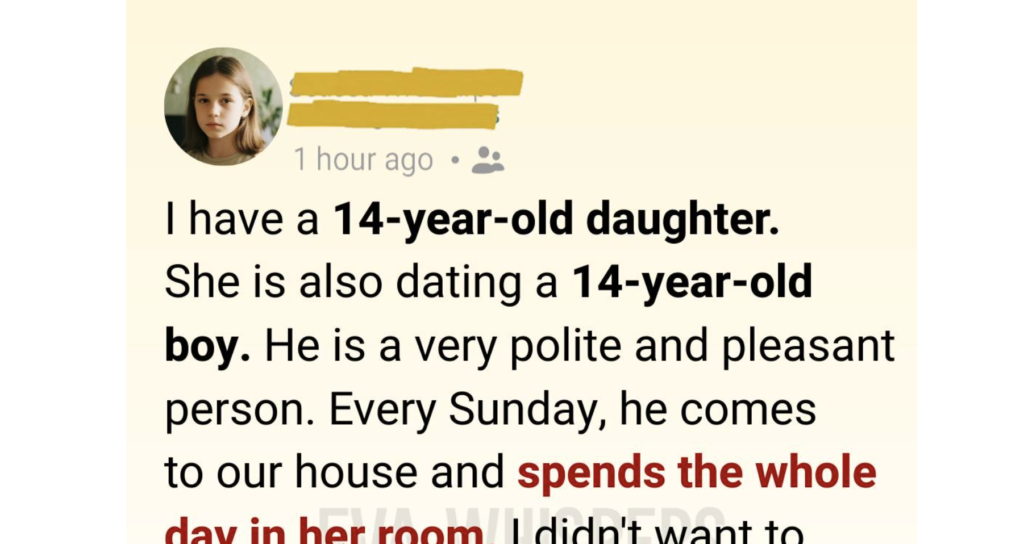
I have a fourteen-year-old daughter, and lately I’ve realized that parenting at this stage means living in a space filled with careful pauses. You exist between trust and concern, between admiration and uncertainty, always trying to protect without controlling, to believe without overlooking reality.
If you are a parent or grandparent to a teenager, this tension likely feels familiar.
My daughter has been spending time with a boy from her class for a few months now. His name is Noah. From the beginning, he stood out in a quiet way. He wasn’t loud or attention-seeking. He greeted adults politely, made eye contact, and spoke with calm confidence. When he visited our home, he asked whether he should remove his shoes. He offered to help carry bags or clear plates. His manners felt sincere, not practiced.
On the surface, there were no warning signs.
And still, something tugged at my thoughts.
Every Sunday afternoon, almost without exception, Noah would arrive shortly after lunch and stay until dinner. The routine never changed. They would go straight to my daughter’s room, close the door, and settle in. There was no music echoing through the hallway. No bursts of laughter. No constant chatter.
Only quiet.
At first, I convinced myself that the silence was reassuring. They weren’t sneaking around the house. They weren’t hiding their time together. My daughter had always been responsible and thoughtful. I reminded myself that trust is something you choose, not something you demand.
Still, worry has a way of arriving softly.
When Doubt Finds Its Way In
One Sunday afternoon, I was folding laundry in the hallway. The house felt calm, warm, and unusually still. I held a towel fresh from the dryer, warmth lingering against my hands, when a single thought entered my mind and refused to leave.
What if I was missing something?
What if my desire to be understanding was clouding my judgment? What if there was something happening behind that closed door that I would later wish I had noticed sooner?
I stood there longer than necessary, staring at the towel, my heartbeat quicker than the moment required. I told myself I wasn’t panicking. I was being attentive.
I decided I would take a look. A brief glance. Something any careful parent might do.
Before I could reconsider, I walked down the hallway. Each step felt louder than the last. I stopped in front of my daughter’s bedroom door, inhaled slowly, and opened it.
I stopped cold.
What I Thought I Would See
My daughter wasn’t sitting on her bed. She wasn’t scrolling through her phone. She wasn’t whispering or laughing.
She was kneeling on the floor.
So was Noah.
Between them was a large piece of cardboard spread across the carpet. It was filled with handwritten notes, sketches, and photographs taped carefully into place. Open notebooks surrounded them. Colored markers lay uncapped nearby. A laptop sat on the bed, paused on what looked like a presentation slide.
They both looked up at me, startled.
“Mom,” my daughter said quickly, her cheeks flushing. “You weren’t supposed to see this yet.”
For a moment, I couldn’t form a response.
“See what?” I asked quietly.
Noah stood immediately, his posture respectful and alert. “I’m sorry,” he said. “We were planning to clean everything up.”
My daughter rose and walked toward me, taking my hand gently. Her voice trembled slightly, though her eyes stayed steady.
“We’re working on something,” she said. “Together.”
A Story Spread Across the Floor
I looked again at the cardboard.
One photograph caught my attention immediately. It was my father, her grandfather, lying in a hospital bed, smiling through fatigue. Another photo showed a small neighborhood park. Another showed a handwritten sign reading Community Literacy Drive.
My chest tightened.
“What is all this?” I asked softly.
My daughter took a breath. “You know how Grandpa has been struggling since his stroke,” she said. “He told me he feels like he doesn’t contribute anymore.”
I nodded.
“Noah’s grandmother helps run a community center,” she continued. “They need volunteers to help children with reading. Grandpa used to be a teacher.”
Noah stepped forward. “We thought he could help plan it,” he said. “Choose books. Help organize activities. Feel needed again.”
I knelt down slowly, studying the materials. There were dates penciled in neatly. A list of responsibilities. A simple budget outline. Draft letters asking neighbors to donate books. One section was titled Making It Fun.
This wasn’t clutter.
It was intention.
“You’ve been doing this every Sunday?” I asked.
My daughter nodded. “We wanted to be sure it could work before telling anyone.”
When Fear Gives Way to Perspective
I sat on the edge of her bed, emotions rising unexpectedly. Every concern I had carried with me dissolved as I took in what stood before me.
I had opened that door expecting to manage a problem.
Instead, I had stepped into compassion.
“I’m sorry,” I said quietly. “I assumed the wrong thing.”
My daughter smiled gently. “It’s okay,” she said.
Noah offered, “You can look through everything if you want.”
I did.
I knelt beside them and studied each detail. I saw care. Planning. Empathy that reached beyond themselves. I saw teenagers learning how to serve someone they loved.
Seeing Them Clearly
That evening at dinner, I watched them with new awareness. They talked about school, books, ideas. I realized how easy it is to underestimate young people when fear takes the lead.
I had walked down that hallway filled with worry.
I walked away carrying pride.
What That Moment Changed
Parenting a teenager requires constant adjustment. It asks for patience, trust, and humility. It means accepting that growth often happens quietly.
That afternoon reminded me that not every closed door hides something harmful. Sometimes it shelters kindness. Sometimes it protects effort. Sometimes it holds young people trying to make a difference in their own way.
I closed that bedroom door feeling grateful.
And I learned that trust, when offered honestly, can reveal more goodness than fear ever predicts.