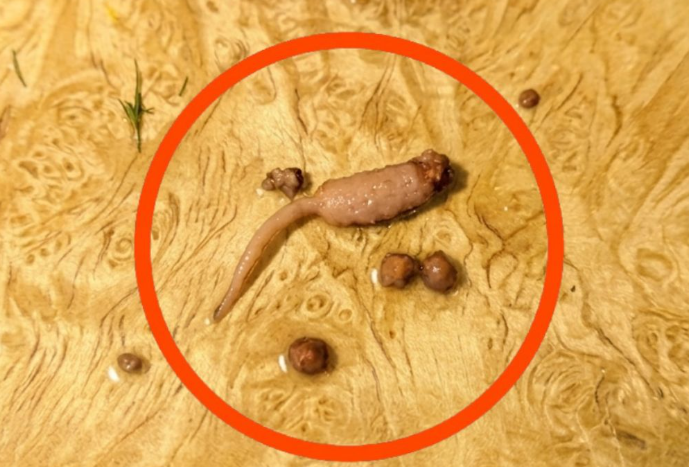
A photograph of a strange, worm-like object found in food has recently caught widespread attention online, leaving many people disturbed and searching for answers.
Highlighted with a bold red circle, the object appears soft, pale, and oddly shaped, sitting among small food particles on a wooden surface. At first glance, it looks deeply alarming, the kind of thing that could easily be mistaken for a parasite or a sign of contamination. This type of image has a way of spreading quickly, precisely because it touches on something deeply instinctive: fear about what we put into our bodies.
The immediate reaction
The first response to a discovery like this is almost always shock. Seeing an unfamiliar, organic-looking shape in food triggers discomfort at a level that is hard to reason with in the moment. Most people assume the worst, and that reaction is entirely understandable. The unusual texture and shape make it seem like something alive or potentially dangerous.
Questions surface almost immediately. Is it a worm? Is the food safe to eat? Should this be reported to someone? That kind of mental spiral is natural, and it happened here too. The image spread quickly online, carrying with it a wave of concern and speculation from people who had never seen anything like it before.
Looking more carefully
Once the initial shock begins to settle, curiosity tends to take over. A more careful look at the object reveals that it does not actually have the defining features of a living creature. There are no visible segments. There is no sign of movement or biological structure. It appears, on closer inspection, more like a thin, stringy strip of material than anything alive.
After further research, the explanation turns out to be far less alarming than the image first suggested. What appears in the photograph is most likely a piece of connective tissue, something like fat or tendon, that has reacted to heat during the cooking process. It is not foreign matter. It belongs to the food itself.
Why meat can look this way
Ground beef and many other types of meat are not made of uniform muscle tissue alone. They naturally contain fat, gristle, and connective tissue running throughout. When these components are exposed to high heat, they respond in ways that pure muscle does not. They can shrink, tighten, twist, and curl into shapes that look nothing like what went into the pan.
In certain conditions, these structures form elongated, pale shapes that bear a striking resemblance to worms or other foreign objects. This visual similarity is entirely a product of how the material transforms under heat. It has nothing to do with contamination, unsafe handling, or the quality of the food source. Anyone unfamiliar with how meat tissue behaves during cooking could reasonably be startled by the result.
Is it actually dangerous?
Despite how unsettling it appears in the photograph, this type of object carries no health risk. It is a natural component of the meat that has changed shape due to thermal exposure. It does not indicate spoilage. It does not suggest the presence of any organism that should not be there. Unpleasant to look at, certainly, but not a reason for genuine alarm when the food has been properly cooked.
That said, if something in a meal ever raises real doubt, the sensible approach is to stop eating and take a closer look. Peace of mind matters, and there is no harm in pausing to investigate before continuing.
What this moment teaches us
Situations like this are a good reminder of how easily appearances can mislead us, especially when the subject is something as personal as food. The photograph circulated widely because it triggered a visceral reaction in people, and that reaction was honest. Something that looks wrong tends to feel wrong, even when a simple explanation exists.
In this case, there is no parasite, no contamination, and no cause for concern. What ended up in that photograph was meat behaving in an unexpected way, doing something that meat sometimes does when heat is applied. Understanding that does not make the image any less strange to look at, but it does make it far easier to move on from.
The more we understand about the foods we cook and eat every day, the less power these moments of confusion have over us. A little knowledge goes a long way toward turning fear into simple, manageable curiosity.