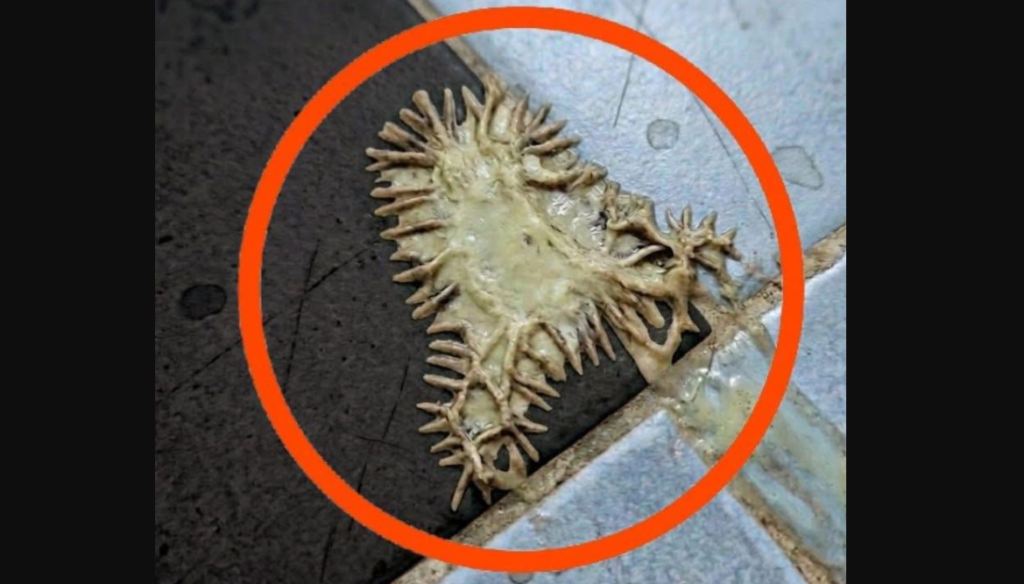
It sat there on the cold bathroom tiles, entirely out of place, quiet, odd, and carrying a faint sense of wrongness that neither of us could quite explain.
My girlfriend and I stood staring at it far longer than we reasonably should have, unable to account for why such a small, shapeless blob produced such an unsettled feeling. It looked like some damp, organic mass, the kind of thing that had no business appearing in a clean, modern bathroom. The longer we looked at it, the less it made sense to us.
We ran through every explanation we could come up with, and somehow each new theory felt more disturbing than the one before it. A parasite? Some rare form of mold? A fragment of something that had worked its way out from inside the walls? With each passing theory, the bathroom began to feel less like a familiar room and more like a place where something had quietly, invisibly gone wrong. Even as we whispered ideas back and forth, part of us recognized we were overreacting, yet the unease remained, stubborn and unmoving.
Two grown adults, completely disarmed by an unidentifiable patch on the floor. It was a strange little reminder of how fragile our sense of normal can become the moment something unfamiliar appears in a space we thought we fully understood. We kept circling it, unable to commit to the idea that it was harmless, but equally unwilling to confirm our worst suspicions.
My girlfriend voiced concerns about toxins or hidden structural damage. I tried to calm her down, though truthfully I felt every bit as uneasy as she did. The real problem was not the thing itself. It was the not knowing. Our imaginations moved into the empty space where facts should have been and filled every gap with something worse than the last.
When we finally discovered what it actually was, a harmless but odd-looking slime mold that commonly appears in damp indoor spaces, the relief did not arrive in one clean wave. There was no danger. Nothing serious. A simple organism doing what organisms do, entirely indifferent to how it had shaken us. We scrubbed the tiles clean, opened the windows wide, and eventually found ourselves laughing at how thoroughly worked up we had allowed ourselves to become.
But something about that moment stayed behind, long after the bathroom was clean again. It was a quiet reminder of how easily the unfamiliar can knock your confidence sideways, even in the most ordinary of settings. Certainty, it turns out, is a fragile thing, and familiarity offers less protection than we tend to assume.
Now, whenever I step into that bathroom, I find myself glancing at the floor without thinking about it. Not because I expect to see anything strange, but because once something ordinary has startled you in a place you thought you knew, it never feels quite the same again.