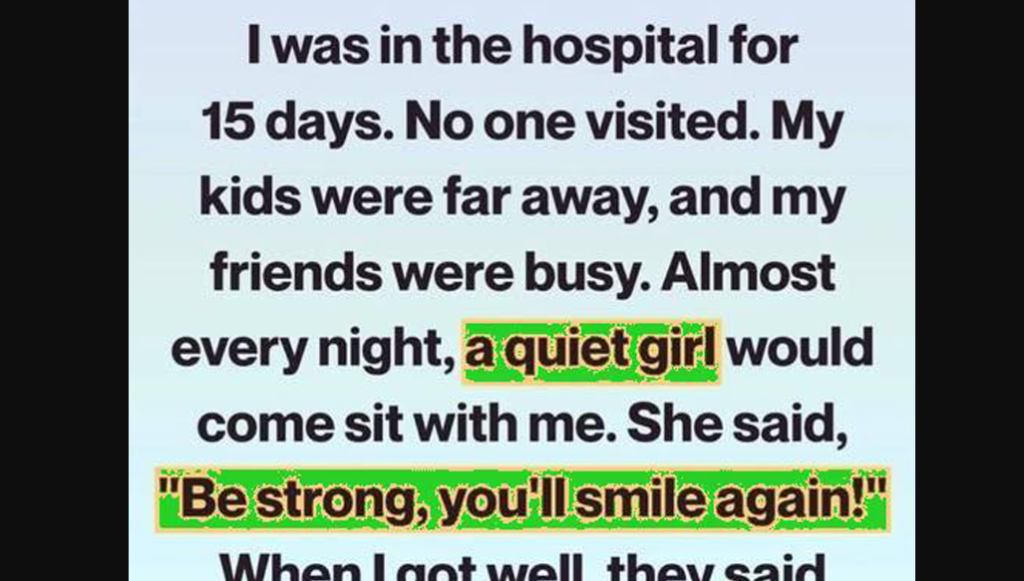
I spent fifteen days confined to a hospital bed after the car accident. Fifteen long days that blurred together beneath harsh fluorescent lights and the constant, rhythmic beeping of machines.
My body had been injured in ways I did not yet fully grasp, and my voice was gone, trapped somewhere in the space between pain and medication. The doctors told me I was fortunate to have survived, but it did not feel like fortune. It felt like being suspended in a still, empty place while time kept moving forward without me. My children lived far away and could not come. My friends drifted back into their own routines. The hours stretched out endlessly, and the nights were the hardest of all.
That was when the loneliness settled in, heavy and complete. Almost every night, a girl appeared in my room. She was quiet, perhaps thirteen or fourteen years old, with dark hair tucked neatly behind her ears and eyes that seemed far older than her years.
She never introduced herself or offered any explanation for why she came. She would pull a chair close to my bed and sit with her hands folded in her lap, as though she belonged there and always had. I could not speak or ask questions, but she seemed to understand that without needing to be told.
One night she leaned a little closer and whispered softly, “Be strong. You will smile again.” Those words became something I held onto in the hours when the pain and fear felt too large to carry alone.
Her presence became the one constant I could depend on through those long hospital nights. When the pain spiked or the silence grew too wide, I found myself waiting for the faint scrape of the chair being pulled close and the quiet comfort that came with it. She never interfered with the machines or the nurses. She stayed, and in a place where I had begun to feel invisible, that small and steady act meant more than I could have said.
When I finally recovered enough to speak, I asked the staff about the girl. Their response was gentle but firm. No such visitor had ever been recorded in the ward. They offered careful explanations, suggesting it had been the medication, the trauma, hallucinations shaped by stress and grief. I accepted that, because I did not know what else to believe.
Six weeks later I was discharged and made my way home, still fragile but grateful to be moving forward. As I unlocked my front door that afternoon, a familiar stillness passed through me, the same feeling I had known during those long hospital nights. Then I saw her standing on my doorstep.
“My name is Tiffany,” she said, nervously twisting her fingers together.
She explained that she was the daughter of the woman whose car had crossed the line and crashed into mine. Her mother had not survived, despite the surgeries and the long nights in intensive care. Tiffany had spent those evenings wandering the hospital corridors, unable to face going home alone. Watching me fight had given her something to hold onto, a fragile hope that survival was possible, that the people she loved might find a way through.
Then she placed something in my hand. A necklace. My grandmother’s necklace, the one I had believed was lost forever in the wreckage of the crash. Tiffany had found it and kept it safe, afraid it might disappear if she left it behind.
I broke down completely. I held her as we both stood there on the doorstep, each of us carrying our grief, and in that shared moment something shifted between us. The weight did not disappear, but it became something we were carrying together rather than separately.
Over the years that followed, the bond between us never faded. I became something like a mother to her, and she remained a steady presence in my life in a way that still moves me when I think about it honestly.
Even now, whenever Tiffany visits and I find myself smiling across the room at her, I think about the quiet girl who pulled a chair beside my bed when no one else could be there. In the darkest stretch of both our lives, her simple and unwavering kindness became the thing that changed everything for both of us.