The call came during my lunch break, and the moment the principal began speaking, I understood this was not the kind of call a parent forgets. He reassured me that my daughter Emma was safe, but asked me to come to the school without delay. As I hurried through the corridors of my workday and out to the car, my thoughts moved faster than I could organize them, searching for any reasonable explanation for what might have happened.
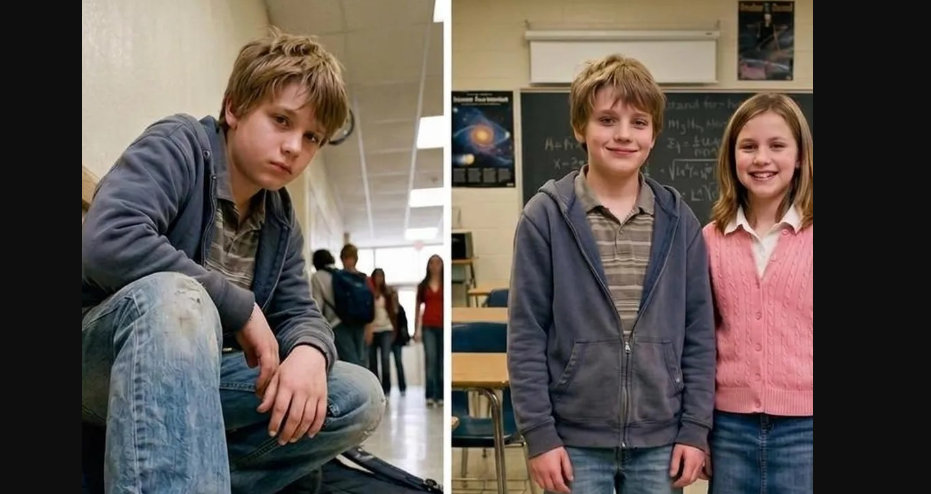
That same morning, I had noticed Emma’s broken piggy bank lying on her bedroom floor. She had explained it calmly, almost matter-of-factly — she had been setting money aside for months, penny by penny, with the goal of buying new shoes for a classmate named Caleb. His worn-out pair had been held together with strips of tape for longer than anyone should have to endure. I had felt a deep, uncomplicated pride in her that morning. As I drove toward the school now, that memory returned with an unexpected weight, as though it had somehow already become part of whatever awaited me.
“She had been setting money aside for months, penny by penny, with the goal of buying new shoes for a classmate named Caleb.”
The principal met me outside his office with an expression that was careful and serious in equal measure. He mentioned only that someone inside wanted to see Emma — and that I would very likely recognize him. A slow, uncertain unease moved through me as I reached for the door handle and stepped inside.
Sitting across the room was Daniel, the former business partner of my late husband, Joe. Years before, when their company collapsed and everything unraveled, Daniel’s public statements had steered the narrative in a particular direction — one that left many people believing Joe had been responsible for the failure. Those words had followed us long after Joe was gone, quietly shaping how others remembered him, coloring conversations and silences alike. Seeing Daniel again stirred emotions I had believed were settled. I had no framework for understanding why he was there, or why he had chosen this moment.
Then Daniel began to speak, and something in the room shifted entirely.
Caleb — the boy Emma had been quietly saving up for — was his son. Daniel had come to express his gratitude in person, and it was during that visit, upon hearing Emma’s last name, that he realized who she was. The recognition clearly affected him. With visible difficulty, and what appeared to be genuine remorse, he said something I had long since stopped expecting to hear from anyone: Joe had not been responsible for what happened to the company. In truth, Joe had tried to stop it. The decisions that led to the collapse had been Daniel’s own, and when the situation began to fall apart, Joe had made the choice to absorb the blame — to protect Daniel, to protect the business, to protect the people connected to both.
For years, Daniel had said nothing. He had been held back by fear and by pride, by the particular silence that settles in when admitting the truth feels more costly than carrying it. What broke through all of that, in the end, was watching his son receive an unexpected, unsolicited act of generosity from the daughter of the man he had wronged.
“What broke through all of that was watching his son receive an act of generosity from the daughter of the man he had wronged.”
A week later, Daniel made a public statement. He took full responsibility for the company’s failure and spoke clearly about Joe’s role — not as a man who had caused harm, but as one who had tried to prevent it, and who had chosen dignity over self-preservation when it mattered most. The statement did not undo the years that had passed. It did not return what had been lost. What it gave me instead was something quieter and perhaps more lasting — a sense of clarity I had not realized I was still waiting for.
That evening, after Emma had fallen asleep, I sat with an old photograph of our family. I had looked at that photograph many times over the years, and there had always been something heavy in it — the weight of a story that had been told wrong, the presence of an absence I could never fully explain to myself or to her. That night, for the first time in a long while, I did not see that weight. I saw the man I had loved. I saw the father Emma still carried with her, in her patience and her generosity and her quiet certainty that other people’s discomfort is worth noticing.
What started with a broken piggy bank and a classmate with taped-up shoes had found its way back to something I thought we might never recover. A child’s uncomplicated instinct to help had moved through the world in ways she could not have predicted and returned to us carrying something we had not thought to ask for.
It is a reminder that small, sincere actions are rarely as small as they appear. They travel. They land in places we cannot see from where we are standing. And sometimes, in ways that resist easy explanation, they bring the truth home.