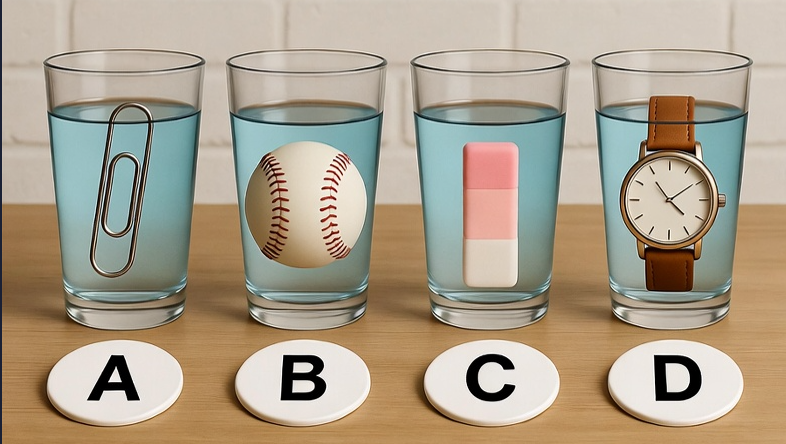
Visual puzzles have a particular way of stopping people mid-scroll. They feel approachable and quick, and yet they often reveal something unexpected about how the mind works. This one is no different. Four identical glasses sit side by side, each labeled with a letter and each filled with water to what appears to be the same level. Inside each glass, a different object rests at the bottom. The question seems straightforward: which glass actually contains the most water? The answer, as it turns out, is more interesting than it first appears.
The four glasses are labeled A, B, C, and D, and the objects inside them are a paperclip, a baseball, an eraser, and a wristwatch respectively. On the surface, the water levels look identical across all four. That visual similarity is precisely what makes this puzzle engaging, because the real answer has nothing to do with how the glasses look and everything to do with a principle of physics.
Understanding Displacement
The concept that unlocks this puzzle is displacement. Every object placed inside a glass of water takes up physical space, and the volume it occupies is space that water cannot fill. The larger the object, the more water it pushes out of the way, and the less actual water remains in the glass even if the surface level appears unchanged.
With that in mind, the answer becomes clear. Glass A, which contains the paperclip, holds the most water. The paperclip is the smallest of the four objects and therefore displaces the least amount of water. More of the glass’s interior volume is available for water to occupy. Glass B, with the baseball, holds the least water despite looking nearly identical from the outside. The baseball is a large, dense object that fills a significant portion of the glass, leaving far less room for water than the other three.
What Your Choice Might Say About How You Think
This puzzle has a definitive scientific answer, and yet many people make their selection based on something other than displacement theory. Some follow instinct. Some focus on visual impression. Some reason through it methodically. Those different approaches offer a loose but entertaining window into thinking styles, and that is where the personality dimension of this puzzle comes in.
“The way a person approaches a visual puzzle often mirrors the way they approach decisions in real life: some follow logic, some trust instinct, and some pause to examine the thing from every angle.”
Choosing Glass A suggests a mind that looks beyond surface appearances and gravitates toward the underlying principle at work. People who arrive at this answer tend to be detail-oriented and methodical, comfortable sitting with a problem long enough to find the logic beneath it. Practicality and precision tend to guide their decisions more than initial impressions do.
Selecting Glass B often reflects a reliance on visual confidence and quick judgment. People drawn to this choice tend to trust what they see immediately and feel comfortable making decisions without extended deliberation. There is a directness to this way of thinking that serves well in fast-moving situations where speed matters as much as precision.
Opting for Glass C tends to reflect a thinking style that holds multiple possibilities open before committing to one. People who land here are often comfortable with ambiguity and willing to revise their reasoning as new information emerges. Flexibility is a genuine strength, and the willingness to reconsider is something they tend to see as an asset rather than a weakness.
Choosing Glass D often points toward a more abstract or emotionally attuned way of engaging with the world. People drawn to the wristwatch may respond to what an object represents as much as what it physically is. They tend to look for meaning beneath the obvious, value experience and depth, and approach problems with a layer of emotional intelligence that purely logical thinkers sometimes overlook.
The Reason Puzzles Like This One Spread So Widely
Visual riddles of this kind travel far because they are quick to engage with, simple to share, and yet they leave people thinking afterward. They invite comparison, spark conversation, and gently challenge the assumption that seeing something clearly means understanding it fully. The lesson embedded in this particular puzzle is a quiet but useful one: what appears identical on the surface can be fundamentally different once the details are examined.
That idea extends well beyond glasses of water. In everyday decisions, relationships, and problem-solving, the visible surface rarely tells the whole story. A small detail, like the size of a paperclip relative to a baseball, can completely change the conclusion a person reaches. Slowing down to notice those details tends to produce better outcomes.
Whether the correct answer came immediately or required a moment of thought, the real value of a puzzle like this one lies in the process of working through it. It asks a person to look more carefully, question first impressions, and apply a principle that is not immediately obvious. Those are habits worth practicing well beyond the puzzle itself.
The truth in this case sits inside Glass A, held in place by nothing more than the modest size of a paperclip. And that quiet, easy-to-overlook detail is exactly what makes it the right answer. Did you pick it?