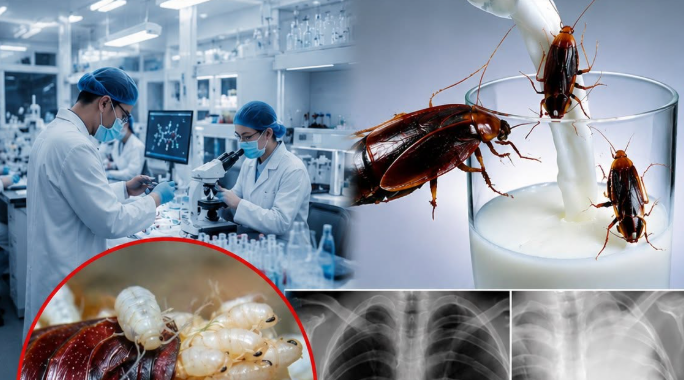
Scientists have identified a distinctive substance produced by a particular cockroach species that displays notable nutritional characteristics.
This discovery has generated interest regarding its possible role as a future food ingredient.
The substance comes from protein crystals formed within the Pacific beetle cockroach, known scientifically as Diploptera punctata.
This species stands out because it gives birth to live young.
Egg laying does not occur in this species.
Developing offspring receive nourishment from a liquid secreted by the mother insect.
Inside the young, this liquid solidifies into protein crystals that function as a concentrated nutritional reserve.
Researchers examining these crystals identified a combination of proteins, fats, sugars, and essential amino acids.
According to findings from the research, the crystals may supply all essential amino acids required by the body.
This characteristic has led some scientists to consider the substance as a potentially complete nutritional source.
Reasons for Scientific Interest
One factor contributing to attention around this substance involves its nutrient concentration.
Analyses indicate that the protein crystals may deliver more energy per unit than an equivalent quantity of cow’s milk.
This observation has prompted investigation into whether the substance could serve as a nutritional supplement or component in specialized food products.
The research remains in preliminary phases.
Although the nutritional composition shows promise, cockroach milk does not exist as a commercial food item at present.
Additional studies are required before large-scale production or approval for general use could occur.
Production Considerations
One significant factor involves the process of obtaining the protein crystals.
Collecting the substance from cockroaches presents challenges due to the small quantities produced by each insect.
In contrast to dairy animals that yield larger volumes, individual cockroaches generate limited amounts of the nutrient-rich material.
Scientists are therefore examining alternative approaches to create or replicate the protein crystals through biotechnology methods.
Success in these methods could enable production of the nutrients without dependence on substantial insect populations.
Safety evaluation represents another key area of ongoing work.
Researchers continue to assess long-term effects on human health and explore possibilities for economic and sustainable production.
Current Status of Research
Headlines sometimes refer to cockroach milk as a potential superfood of the future.
Experts emphasize that the concept remains in the experimental phase.
Current efforts focus on understanding the nutritional advantages of the protein crystals and determining whether comparable compounds could be manufactured at larger scales.
At this stage, cockroach milk stands as one of the more distinctive findings in food science research.
Whether the substance eventually develops into a commercial product or contributes to broader advances in nutrition studies, it has already prompted global interest and conversation.
The concept may appear unconventional at first consideration.
Historical patterns show that various foods once viewed as unusual later gained acceptance within contemporary diets.
As scientific work progresses, the development of cockroach milk continues as a topic that draws attention from researchers and the public alike.
Potential Applications Under Study
The high concentration of essential amino acids within the crystals supports exploration of possible uses in nutrition.
Scientists are examining how these compounds might complement existing dietary options in specific contexts.
The energy density observed in the crystals has led to consideration of applications where concentrated nutrition could provide value.
Biotechnology approaches under investigation aim to address production limitations while maintaining the nutritional profile.
These efforts include laboratory methods that could replicate the beneficial components without direct extraction from insects.
Ongoing safety studies contribute to understanding appropriate conditions for any future use.
Regulatory processes would require comprehensive data before any commercial introduction.
The research process involves collaboration across multiple scientific disciplines.
Findings from these studies continue to inform understanding of novel nutritional sources.
Public interest in the topic reflects broader curiosity about innovative approaches to food and nutrition.
Scientific communication helps clarify the current stage of development and the questions still under investigation.
This transparency supports informed discussion about potential future possibilities.
Looking Ahead
The discovery of nutrient-rich protein crystals from Diploptera punctata has opened new avenues for research in food science.
Continued work will determine whether these findings translate into practical applications.
The emphasis remains on thorough investigation of nutritional benefits, production feasibility, and safety considerations.
As studies advance, additional information will become available regarding the substance and its potential role.
For now, the research contributes to expanding knowledge about diverse sources of nutrition found in nature.
The process highlights how scientific inquiry can reveal unexpected properties in various organisms.
Interest in cockroach milk demonstrates the ongoing exploration of unconventional resources that may support future nutritional needs.
Researchers maintain focus on evidence-based development while addressing technical and safety requirements.
This approach supports responsible advancement in the field of food innovation.
The story of cockroach milk illustrates how scientific discovery can generate both curiosity and practical investigation into new possibilities for nutrition.
As work continues, the topic remains relevant for those following developments in food science and related fields.