The brass plaque bolted beside the heavy oak doors of Cedar Summit Lodge had been tarnished by thirty winters of mountain sleet, yet every time Edmund Hale used to visit, he would rub the corner with his thumb until the words caught the lobby light: Every guest matters here.
His late wife, Beatrice, had commissioned that plaque in 1995, the autumn they sank every dollar of their savings into restoring the timber-frame property along the Blue Ridge Parkway. At the time, it was barely more than a sagging roof and a stone chimney. Together, they turned it into the flagship of a seven-property hospitality group—not by chasing luxury magazines, but by treating a trucker in muddy boots with the exact same warmth as a neurosurgeon arriving in a Mercedes.
Three years after Beatrice passed away from leukemia, sixty-eight-year-old Edmund finally packed an overnight bag, climbed into his rusted 2004 Ford F-150, and made the six-hour drive into the mountains. He hadn’t booked through the executive office, and he hadn’t told the general manager he was coming. All he wanted was to spend one quiet Friday night in Room 312—the corner balcony suite where he and Beatrice had celebrated twenty-eight anniversaries—before the November snow closed the upper ridge.
He never made it past the front desk.
By 8:30 PM, rain was hammering the cedar shingles sideways. Edmund stood at the reception counter in a damp flannel jacket while a young clerk named Mallory tapped slowly at her terminal. Two minutes earlier, he had watched her check in a couple wearing matching Patagonia vests for the standard $180 autumn rate. When Edmund asked for the single-night key to Room 312 he had reserved by phone that afternoon, Mallory slid a printed folio across the marble counter without looking up.
The total before tax was $1,400.
Stacked beneath the $180 room charge were five vague line items: a Mountain Experience Package, an Exclusive Arrival Service, a Guest Enhancement Fee, a Nonrefundable Premium Tier, and—the line that made Edmund’s jaw tighten—a $240 Heritage Preservation Fee.
Four months earlier, Edmund had signed an executive memo eliminating that exact fee across every property in his company, and Cedar Summit’s general manager, Preston Shaw, had replied in writing confirming it had been scrubbed from their billing software.
When Edmund calmly pointed out the discrepancy, Mallory glanced past his shoulder through the glass doors at his mud-streaked pickup idling under the portico. Her tone dropped into practiced condescension: different guests qualified for different tiers, and if the rate didn’t fit his budget, nobody was stopping him from sleeping in the cab of his truck.
Moments later, Preston Shaw stepped out from the back office in a tailored charcoal suit. Having taken over management two years earlier—right when Edmund stepped back from site visits to care for Beatrice—Preston knew his boss only as a signature at the bottom of corporate emails. He didn’t ask for an ID. He didn’t check the reservation name. Looking at Edmund’s worn boots and weathered truck, Preston declared Room 312 suddenly unavailable, insisted the $1,400 surcharges were non-negotiable, and motioned for the night security guard, Eli, to escort him off the premises.
Eli looked out at the freezing downpour and hesitated, clearly uncomfortable, until Preston snapped at him to stop wasting time. Edmund didn’t argue or reach for his wallet. On his way out, he paused just long enough to push aside an oversized potted ficus that had been dragged directly in front of Beatrice’s brass plaque, then walked out into the rain.
Rather than risk six hours of black ice on the mountain switchbacks in the dark, Edmund backed his pickup into a corner space near the service entrance, running the heater in ten-minute intervals to keep the chill off the windshield.
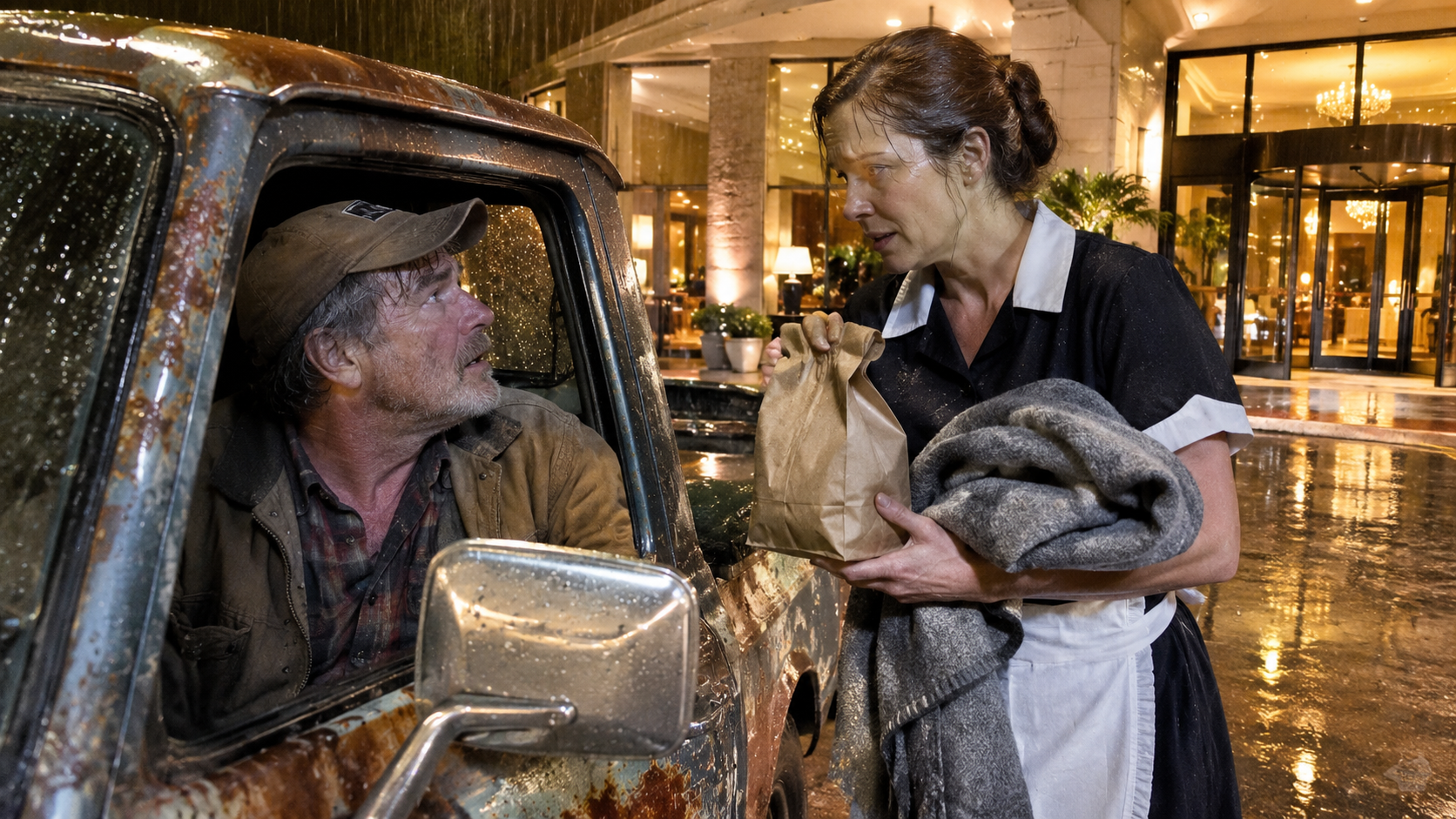
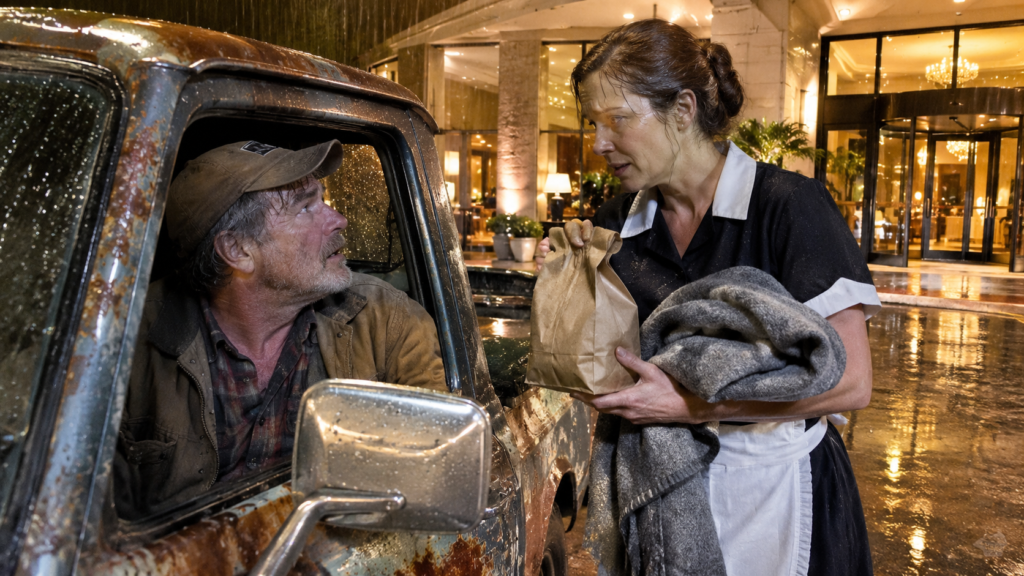
Just after two in the morning, a sharp tap on the passenger glass startled him awake. Standing in the sleet was a woman in a maroon housekeeping uniform clutching a stainless-steel thermos, a folded wool blanket, and a foil-wrapped plate.
Her name was Rosa Santos, and she had stripped beds and scrubbed bathrooms at Cedar Summit for nine years. Seeing an older man sitting alone in a cold cab during a storm, she had warmed up chicken and rice from the staff kitchen and brought it out on her break. Once she climbed into the passenger seat out of the wind, Edmund asked a simple question: How long has the front desk been pricing people out based on what they drive?
Rosa stared toward the glowing lobby windows before answering. Since Preston’s arrival, staff had been instructed to slap fabricated “tier packages” onto walk-in travelers driving older vehicles, retirees, or working-class families—driving them away so Preston could either hold suites for high-tipping corporate clients or pocket cash differences on off-book rentals. Worse, when Rosa had bypassed local management and emailed the regional compliance hotline two months earlier, she had been called into Preston’s office seventy-two hours later and threatened with termination—proving that someone inside Edmund’s own regional headquarters was intercepting whistleblower complaints and feeding them straight back to the manager.
Edmund wrote down the date and timestamp of Rosa’s email in his pocket notebook, thanked her, and waited for daylight.
At 7:45 AM, when the morning shift clocked in and two regional forensic auditors arrived from Asheville at Edmund’s dawn summons, the front lobby looked very different. Edmund walked through the oak doors carrying his leather briefcase, his Hale Mountain Hospitality founder credential clipped squarely to his lapel.
Preston was standing behind the counter reviewing arrival sheets with Mallory. He started to bark at security to remove the trespasser from the night before—until his eyes dropped to the embossed gold seal and the name printed beneath it: Edmund Hale.
Within twenty minutes, the regional auditors pulled the back-office point-of-sale logs. The digital trail was undeniable: over fourteen months, Preston and Mallory had manually tacked bogus surcharges onto dozens of cash-paying guests, voided the fees in the system after checkout, and split more than $48,000 in skimmed overcharges—wiring a monthly cut directly to a regional compliance supervisor who had been burying staff complaints.
Before noon, Preston, Mallory, and the regional supervisor were terminated for cause and turned over to the county sheriff’s financial crimes division.
That afternoon, Edmund promoted Eli, the security guard who had hesitated to throw an old man into a winter storm, to night operations supervisor. Then he walked down to the first-floor laundry room and asked Rosa Santos to step into the lobby, where he handed her an offer letter naming her Cedar Summit’s new Assistant General Manager—complete with a $28,000 salary increase and full profit-sharing.
Before driving back down the mountain on Sunday morning, Edmund had maintenance haul the oversized potted plant out to the back patio permanently, leaving Beatrice’s brass plaque in plain view beside the front doors where it belonged.
Editorial Note: While inspired by real-life hospitality dynamics and workplace ethics, this story is a work of creative fiction written for entertainment purposes. Names, characters, and specific events have been dramatized.