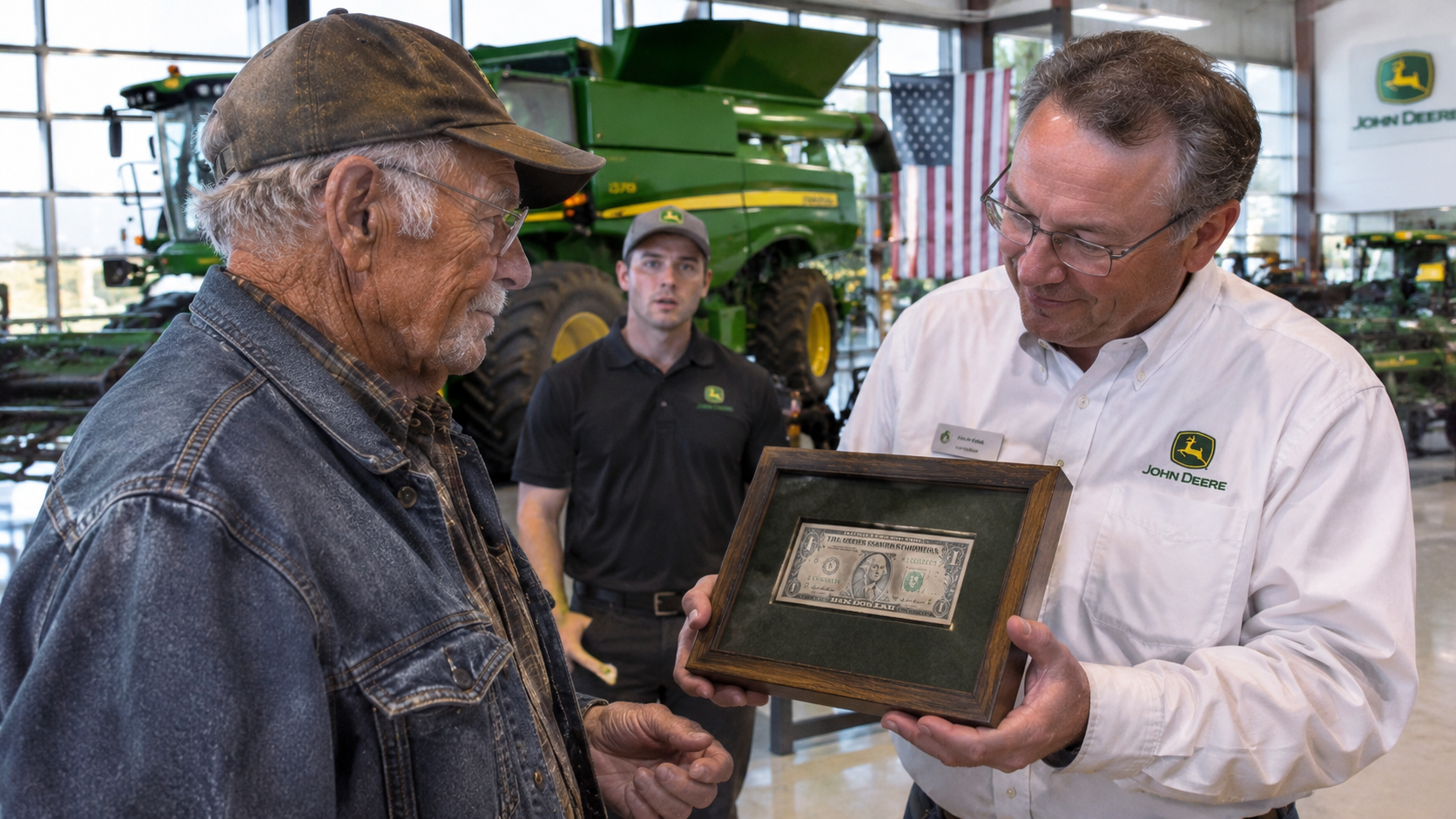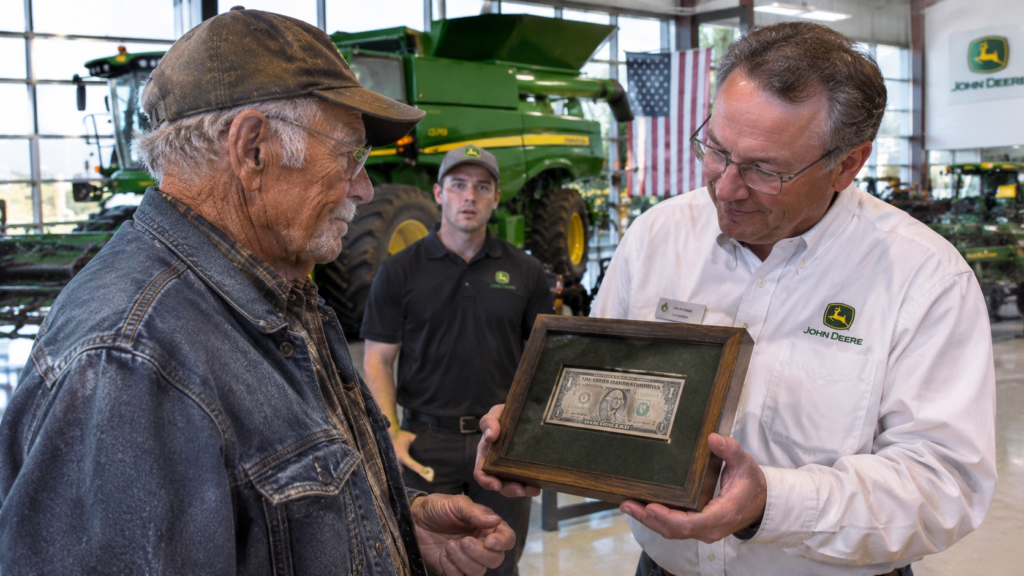
Above the back office door of the sprawling John Deere dealership along Highway 163 in Pella, Iowa, hangs a small black wooden frame holding a single, creased 1985 one-dollar bill with blue ballpoint ink running straight across George Washington’s forehead. Most customers walking past the glass showroom never notice it, and the twenty-something sales staff rarely bother to ask why the owner keeps a wrinkled single mounted over his lintel like a family heirloom.
On a crisp Tuesday morning in late October, a twenty-five-year-old salesman named Jaxon learned the hard way—right in front of the parts counter, a stunned cashier, and his own boss.
Around Marion County, everybody knows Harm Vander Linden. At eighty-four, Harm still farms nine hundred acres of bottomland corn and soybeans south of Pella—the exact quarter-sections his grandfather broke with a four-horse team in 1911. Even now, Harm runs the twelve-row planter himself every May because he doesn’t trust anyone else to set the seed depth properly. He has never cared much for appearances. His late wife, Hennie, used to tease him before she passed away in 2021 that he dressed like a scarecrow that had given up on life: faded seed caps, patched bib overalls, and a canvas barn coat held together at the collar with a loop of orange baling twine where the top brass button used to be.
For twenty-eight seasons, Harm had harvested his fields with a 1998 combine. It had rattled, smoked, and needed biannual welding on the grain tank, yet it always brought the crop in—until September, when the main rotor gearbox sheared apart in the middle of the north eighty. Harm finished bringing in the beans with a borrowed machine from his neighbor’s son, then made up his mind. His grandson, Pieter, was finishing his senior year in agronomy at Iowa State and planned to take over the farm in two springs. Harm wanted to leave the boy a machine that wouldn’t die on him in the middle of harvest.
So on Tuesday morning, straight after chore time, Harm drove his dusty pickup out to the gleaming glass-and-steel dealership on Highway 163. The old concrete-block shop had been torn down in 2019 to make way for the new facility, complete with a polished showroom floor and a row of brand-new green combines lined up out front like a parade.
Two young salesmen were leaning against a high-top table near the coffee station. One of them—wearing a crisp quarter-zip pullover, a smartwatch, and hair styled with enough product to withstand a prairie gale—walked over with a practiced grin. His name tag read JAXON.
When Harm pointed through the front glass at the flagship X9 combine equipped with a thirty-five-foot draper head and asked to talk numbers, Jaxon’s eyes traveled slowly from Harm’s hog-lot boots up to the baling twine on his coat. Without losing his polite smile, Jaxon explained that the machine ran six hundred twelve thousand dollars, that financing alone required a two-hour sit-down, and that he ought to walk Harm somewhere “more useful.”
He led the eighty-four-year-old farmer straight past the leather chairs and across the showroom to the parts counter, announcing loudly enough for his colleague at the coffee table to snort that used lawn tractors were parked on the north lot—and that the big combines were meant for “real farmers, operators.”
The young woman behind the parts register stared down at her keyboard, her cheeks turning bright red. Harm didn’t raise his voice or argue. He simply rested his elbows on the laminate counter, looked at the wall of framed black-and-white photographs from the dealership’s early decades, and waited.
In one faded 1985 snapshot, a gaunt man in a short-sleeved work shirt stood outside a tiny concrete-block building beneath a hand-painted wooden sign. Harm recognized the building, the sign, and the man—Arie Bosma—because 1985 had nearly buried both of them.
Half an hour passed. Nobody offered Harm a cup of coffee. Jaxon strolled back to his high-top table, showed something on his phone to the other salesman, and laughed.
Then the heavy oak door to the back office swung open. A broad-shouldered man in his early sixties stepped out scanning an invoice sheet, wearing the exact square jaw of the man in the 1985 photograph. It was Arie’s son, Dirk Bosma, who now owned the dealership.
Dirk glanced up toward the parts counter. He froze mid-step. He looked at Harm’s twine-fastened barn coat, looked across the floor at Jaxon leaning against the coffee table, and then looked back at Harm.
Without saying a word, Dirk turned around, walked back to his office doorway, reached up with both hands, and lifted the small black frame off the two finishing nails above the trim. He carried it across the showroom floor slowly, holding it with both hands like a church deacon carrying the Sunday offering plate. Every conversation in the building stopped. The two salesmen straightened up.
Dirk stopped directly in front of Harm and held out the frame.
“Harm,” Dirk said quietly, his voice rough. “I am sorry. I didn’t know you were standing out here.”
Then Dirk turned toward the coffee station, his expression hardening into stone. “Jaxon. Get over here. Read me the name signed in blue ink across George Washington’s face on this bill, and then tell me what you think it bought.”
Jaxon walked over slowly, squinting through the glass. Written across the portrait in faded ballpoint were two names: Harm & Hennie Vander Linden.
Dirk tapped the frame with a thick knuckle. “In October of 1985, interest rates hit eighteen percent and the regional bank called my father’s operating note. They had a sheriff’s auction scheduled for Friday morning. My dad was sitting in that little block building with the lights off because he couldn’t pay the electric bill, ready to hand over the keys.”
Dirk’s voice carried clearly across the silent showroom. “Harm here walked through the front door carrying a three-pound Folgers coffee can. Inside was every dollar he and his wife Hennie had saved over twenty years—cash they’d set aside to build a new machine shed and buy ground of their own. Harm walked down to the bank, bought my father’s defaulted note for one dollar more than the liquidators offered so the bank couldn’t touch him, carried the paperwork back to that block shop, and tore it in half on my dad’s desk.”
The girl behind the parts counter pressed both hands over her mouth. Jaxon stared at the floor, the color draining completely from his face.
“Harm didn’t ask for interest, and he didn’t ask for a percentage of the business,” Dirk continued. “He pulled a single wrinkled dollar bill out of his pocket, asked my father to sign his name next to his on the front, and told him to pay it forward whenever he got back on his feet. Every service bay in this building, every truck on that lot, and every paycheck you deposit into your bank account sits on top of that dollar.”
Dirk turned back to Harm, his tone softening immediately. “Pick whichever X9 on the front line you want, Harm. Have the shop prep the thirty-five-foot head and deliver it to your yard before noon. And wait right here—there’s something my father locked in the bottom drawer of the safe before he passed away in 2016, specifically for the day you finally came in to buy a new machine.”
Two minutes later, Dirk returned carrying a yellowed, wax-sealed manila envelope with Harm’s name written across the front in Arie Bosma’s neat block handwriting. Inside was a paid-in-full equipment credit certificate backed by a private escrow trust Arie had funded quietly over thirty years—covering the entire purchase price of a flagship combine, down to the last dollar, alongside a handwritten note that read: You saved my family’s name when nobody else would stand beside us. Let us put the next generation of Vander Lindens in the cab.
When the gleaming green X9 rolled onto the gravel lane south of Pella on a lowboy trailer the next morning, Harm stood beside the barn with his hands tucked into his bib overalls, watching the sunlight glint off the new paint. He pulled out his phone, snapped a photo of the thirty-five-foot header, and texted it to his grandson Pieter in Ames with four words: Finish your finals, boy.
Editorial Note: While inspired by real-life rural history and small-town business traditions, this story is a work of creative fiction written for entertainment purposes. Names, characters, and specific events have been dramatized.