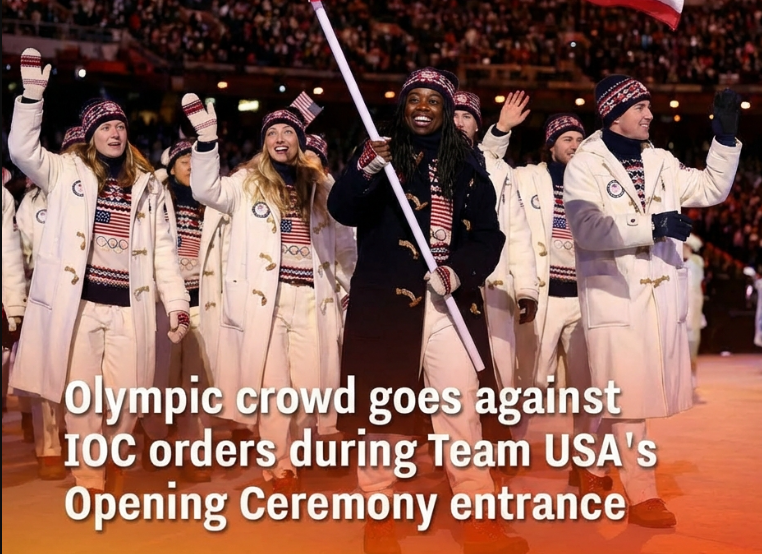
What was intended to be a moment of harmony and celebration at the 2026 Winter Olympics shifted unexpectedly into one of the most widely discussed scenes of the opening ceremony. As Milan’s stadium glowed under sweeping lights and a soundtrack crafted for grandeur, excitement radiated across the arena.
The athletes had begun their long walk, the cameras swept across the stands, and the atmosphere carried the familiar sense of anticipation that marks the start of every Olympic Games. Then the giant screens displayed Team USA advancing into view. Within seconds, sections of the audience erupted into loud boos, a reaction that cut sharply through the music and altered the emotional temperature of the night.
Organizers had spent days urging spectators to focus on unity, reminding everyone that the Olympics were designed to rise above politics. Yet the response from pockets of the crowd reflected something deeper taking shape beyond the stadium walls.
Earlier that day, demonstrations had filled parts of Milan, fueled by anger over U.S. immigration enforcement policies. While the organizing committee appealed for neutrality, the presence of global emotions at a global event created an environment where even a routine team entrance carried unexpected weight.
Online conversations mirrored the division immediately. Many viewers expressed sympathy for the athletes, pointing out that individual competitors were not responsible for their country’s political decisions. Others argued that the reaction revealed a growing frustration felt by many around the world, and the stadium became one of the few places where that frustration could be expressed openly.
The political current surrounding the moment strengthened further when Gus Kenworthy, competing for Team GB, shared a message criticizing U.S. immigration enforcement shortly after the ceremony concluded.
His comments spread rapidly across social media, adding a new layer to the already developing debate. The Olympic Committee reiterated its commitment to maintaining neutrality, emphasizing again that athletes should be able to compete without becoming vessels for international disputes. Even so, the atmosphere made it clear how challenging it has become to separate global sport from global issues.
Despite the tension, the opening ceremony continued with its full program — orchestral performances, choreographed displays, cultural tributes, and the traditional parade of nations. The artistry of the evening still carried the spirit of the Games, with the organizers ensuring that every participating country received its symbolic moment of welcome. These elements served as reminders of what the Olympics have always intended to represent: connection, cooperation, and the pursuit of excellence through peaceful competition.
Still, for many watching in person and at home, the entrance of Team USA stood out as the moment that defined the night. It offered a window into a growing truth of modern international events: even celebrations built on unity can be shaped by the emotions of a global audience. The stadium in Milan became a reflection of the world outside its gates — a world where politics, sports, identity, and collective expression are increasingly intertwined.
As the Games moved forward, athletes focused on their performance, organizers worked to reinforce messages of respect, and spectators around the globe continued debating what they had seen. The boos directed at Team USA became more than a fleeting reaction; they became a symbol of the complex environment in which modern athletes now compete. And while the competition itself promised moments of triumph and inspiration, the opening ceremony demonstrated how deeply world events can echo through even the most carefully planned displays of unity.