Grandma Mae raised five kids and helped raise all seven of us grandkids on a cleaning lady’s paycheck.
Every night at 9 p.m., she took the 42 bus downtown to the Harrison & Cole law building. She cleaned all eleven floors, emptied every trash can, and polished the brass on the elevator doors because, she said, “if you’re going to do something, do it so nobody has to do it after you.”
She came home at 3 a.m., slept four hours, and was in the kitchen making grits and salmon croquettes before we woke up for school.
She never missed a Sunday at Greater Bethel AME. She never missed a birthday. She sang alto in the choir for forty years and could still hit the high note in “His Eye Is on the Sparrow” at seventy-eight.
She lived in the same small brick house on Wallace Street her whole adult life. She wore the same church hat every Easter. She cut coupons, reused aluminum foil, and kept a coffee can of quarters on top of the fridge for “emergencies.”
We thought we knew everything about her.
THE MAN IN THE BACK PEW
Grandma Mae passed in October, in her sleep, in her own bed. She was eighty-one.
The church was packed for the funeral. People stood along the walls. The choir sang her favorite hymns, and Pastor Greene talked about how she had brought a sweet potato pie to every grieving family in the neighborhood for half a century.
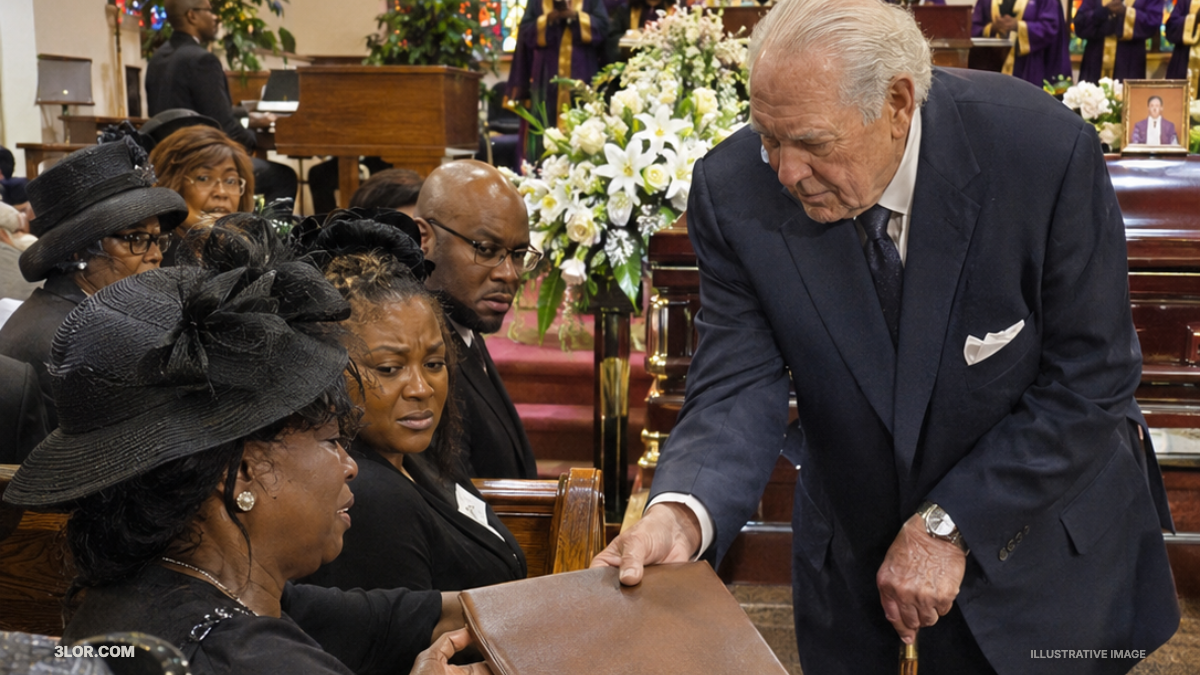
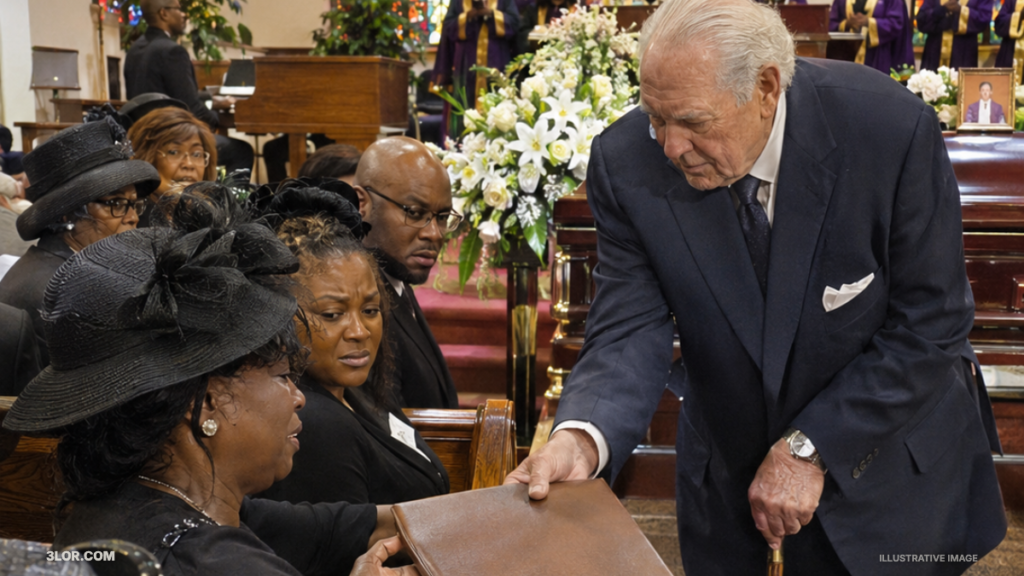
Halfway through the service, an old white-haired man in an expensive navy suit stood up from the back pew.
Nobody knew who he was. My uncles looked at each other.
He walked slowly to the front of the church, leaning on a cane, and asked the pastor if he could say a few words.
“My name is Thomas Harrison,” he said. His voice was shaking. “I’m the senior partner at Harrison and Cole. Mae cleaned our building for thirty-one years.”
He paused.
“But that is not how I knew her. Mae was the most important person in my life. And she made me promise to do something today.”
Then he walked straight to my mother in the front row and handed her a thick brown folder.
My mother opened it. Inside were seven sealed envelopes. Each one had a name on it, in Grandma’s handwriting.
Our names. All seven grandchildren.
1979
Mr. Harrison stayed standing in front of the casket and told us the story.
In the winter of 1979, he was twenty-four years old, a first-year law student with no family and no money. His scholarship had been cut. He had been sleeping in the law library and, when they locked it at night, in the stairwell of the downtown office building where he worked as a mail clerk.
One night, at 2 a.m., the cleaning lady found him there. Asleep on the concrete steps in his only coat.
She didn’t call security.
She brought him a thermos of coffee and a foil-wrapped plate of fried chicken and greens. The next night, she brought him a blanket. The next week, she brought him to her house on Wallace Street and gave him the couch.
He lived there for two years.
“She fed me,” he said. “She ironed my one shirt every night for job interviews. And when I told her I was going to drop out because I couldn’t pay my tuition, she went into her bedroom and came back with a coffee can.”
The whole church went quiet.
“It was every dollar she’d saved for nine years. She told me, ‘You pay me back by being the kind of lawyer who helps people like us.'”
THE PROMISE
He finished law school. He paid her back within five years, with interest she tried to refuse. He became a partner. Then senior partner.
And when she asked him for a job, because her husband had passed and she needed the money, he offered her an office job with a salary three times what she’d make cleaning.
She said no.
“I like my quiet,” she told him. “And I like knowing the building is clean.”
So he did the only thing she would allow.
For thirty-one years, every dollar of her paycheck that she set aside, she brought to him. And every year, on her birthday, he added the same amount from his own pocket. He invested all of it. She made him swear never to tell a soul.
“She said her grandbabies were going to college,” Mr. Harrison said, “and nobody was going to have to sleep in a stairwell.”
THE ENVELOPES
We opened them in Grandma’s living room that night, all seven of us, sitting on the plastic-covered sofa she never let anybody sit on.
Each envelope had a statement from a trust account in our name. Enough for four years of college, anywhere we wanted to go. For the three of us who had already graduated, enough to pay off every dollar of our student loans.
And each envelope had a handwritten note.
Mine said:
“Baby, I cleaned other people’s floors so you would never have to clean up after anybody’s mistakes, including your own. Go be somebody. And call your mama on Sundays. Love, Grandma.”
My cousin Darnell, who is six-foot-four and hasn’t cried since he was nine, had to go stand on the porch.
Mr. Harrison still comes to Greater Bethel on the first Sunday of every month. He sits in the back pew, in Grandma’s honor.
And every Easter, my mother wears that same church hat.
This story is a work of fiction. Names, characters, and events are products of the author’s imagination. Any resemblance to actual persons, living or dead, is purely coincidental.