I once believed the lowest point was sleeping behind a dumpster, using a damp sock as a pillow. But I learned that rock bottom has its own depths, layers that unfold in unexpected ways.
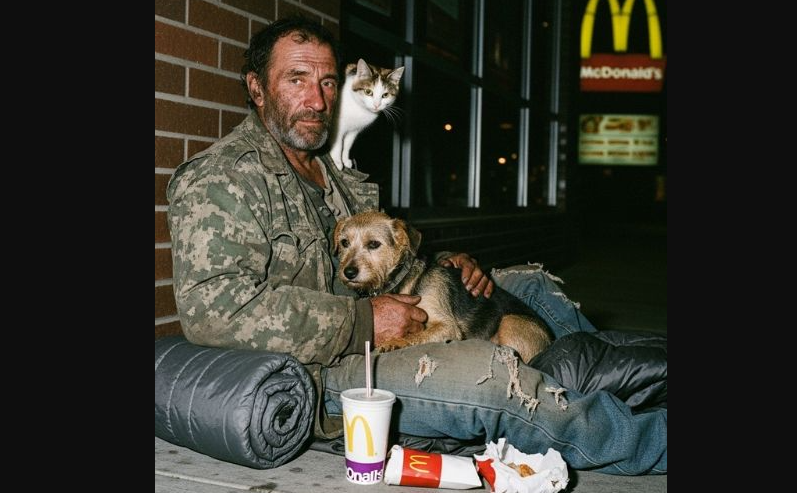
That night, I was camped out near the McDonald’s at 6th and Emery, splitting chicken nuggets with Baxter, my dog, and the cat I hadn’t yet named. It had been nearly two days since my last meal, and my stomach growled louder than the passing buses.
A man pulled up in a gleaming Subaru, dressed in a designer puffer vest, his hair slick with gel, radiating that polished influencer vibe. He knelt down, his tone dripping with rehearsed sincerity, and said, “That jacket’s got soul. I’ll trade you a sandwich and ten bucks for it.”
I chuckled and declined at first. That jacket had been with me through two tours in the desert, carrying sand and blood in its stitches. But my hands trembled, Baxter whimpered, and the cat was already eyeing the sandwich like it was a treasure.
So, I gave in.
He handed over the sandwich, took a quick photo without my permission, and drove off.
Three days later, someone pointed out a billboard at Ashwood and 14th. There was my jacket, draped over that same guy, blown up 20 feet tall with bold text:
“VETERAN VINTAGE. RAW. REAL. RECLAIMED.”
I stood there, fries in hand, Baxter curled at my feet, wondering if this was some cruel prank. Then I spotted the fine print:
@MilesMilano | Ethical Streetwear Launching Soon
That name hit me hard.
Miles Milano wasn’t some random stranger. He was my bunkmate for seven months in Ramadi—a wiry, sharp-tongued kid from Brooklyn who enlisted to prove his dad wrong. We lost touch after we got out. Last I knew, he landed a tech job.
We weren’t close, but we’d shared MREs and dodged IEDs together. Seeing him up there, turning my story into a fashion statement? That burned deeper than any desert heat.
I stared at the billboard for what felt like hours, then walked away.
For the next week, his face was inescapable—on bus stops, Instagram reels, even a TikTok ad where he swaggered through an alley in my jacket, captioned, “From war to wear.”
It turned my stomach.
I didn’t own a phone, but a kind girl at the shelter let me borrow the community laptop for a few minutes daily. I looked him up. His brand had just launched, already earning buzz. A glossy website called him a pioneer of “sustainability through meaningful stories.”
But that story? It belonged to me.
I considered letting it slide. Maybe I was envious or stuck in my own head. Then I saw the price tag: jackets “inspired by real veterans” for $850.
I’d earned $9 that week collecting bottles.
Anger surged, but more than that, I felt violated.
One evening, I sat beside an older woman feeding pigeons in the park. I hadn’t meant to share, but the story spilled out. Her name was Riley, a journalism student. She asked if she could write about it. I agreed, not expecting much.
She followed through.
Two weeks later, her article appeared in a small online magazine, City Echo.
Title: “The Jacket, the Sandwich, and the Lie: How One Vet Got Turned Into a Marketing Gimmick.”
I figured a handful of people might read it. But it spread—picked up by one site, then another, then more.
At the shelter, folks started patting my back, handing me hot coffee, saying I’d done something courageous. I didn’t feel courageous. I felt raw, like I’d bared my wounds to the world.
Then something extraordinary happened.
Emails flooded into the shelter for me. Strangers offered support. Donna, a diner owner downtown, gave me a dishwashing job with meals included. A retired Navy vet offered a camper van parked behind his shop.
The biggest surprise came from a charity called Rucksack to Roots. They’d read the article and wanted to help homeless vets like me with housing, therapy, and job training.
I hesitated. I’d been let down before. But the man’s steady gaze told me he wasn’t another Miles.
I took the leap.
They set me up in a small studio on the east side. The first night on a real mattress, I wept. Baxter snored beside me, and the cat—now named Peaches—curled up nearby.
Meanwhile, the internet turned on Miles. Others came forward: a woman whose grandfather’s military letters were used in his ads, a Detroit artist whose mural was copied onto his “limited edition” hoodies.
Brands dropped him. Influencers unfollowed. He posted a somber black-and-white video about “miscommunication” and “artistic vision.”
It didn’t land.
The billboard came down.
Something better replaced it.
Riley, who’d kept in touch, told me a local artist wanted to paint a mural where the billboard stood. She asked if I was okay with it.
I shrugged and said yes, not expecting much.
A week later, I walked by that intersection and stopped dead.
It was me—sitting cross-legged with Baxter and Peaches, a sandwich in one hand, my army jacket folded beside me. Not polished or staged, just me.
Above it, the words:
“Real Stories Deserve Respect.”
I stood there, unnoticed by passersby, staring at my own image.
For once, I didn’t mind.
Months passed. I started working full-time at Donna’s diner, moving from dishes to prep work. Baxter became the diner’s unofficial mascot, sporting a bandana. Peaches claimed her spot on my counter at home, nestled by the space heater.
Riley invited me to speak at her college. Public speaking terrified me more than a Baghdad summer, but I agreed. I stood before sixty students, voice shaky, hands trembling, and told my story—not just the jacket, but the fall and the climb back. I spoke about how easy it is to overlook people when they seem “useless.”
Afterward, a student approached, tears in his eyes, asking how to help his veteran uncle who never got support.
That moment outweighed any paycheck.
Weeks later, a package arrived, no return address. Inside was my jacket—cleaned, repaired, folded with care. A note tucked in the pocket read:
“I didn’t know what I was doing. I’m sorry. I don’t deserve forgiveness, but you deserve this back. —Miles”
I felt a tangle of emotions—anger, relief, maybe closure.
I still wear that jacket, not daily, but when it’s cold or when I need to remember my roots.
I’ve learned some will always try to profit off pain, but others will show up with kindness when life gets messy—people like Riley, Donna, and Rucksack to Roots.
My life remains simple. I drink coffee from a chipped mug, eat canned soup too often. But I have a door that locks, a job that matters, and animals who love me unconditionally.
My story is mine again.
Here’s my advice: don’t let anyone twist your truth into something marketable. It’s okay to struggle, to break. What matters is who helps you rebuild.
If you trade your jacket for a sandwich, make sure it’s your decision, not someone else’s gain.
If this story resonates, share it. Someone out there might need it. And maybe give it a like—it could amplify the voices that deserve to be heard.