The Nobel Peace Center has issued a statement following a highly unusual public act involving Venezuelan opposition leader María Corina Machado and U.S. President Donald Trump. Machado, who was awarded the Nobel Peace Prize in October 2025 for her work defending democratic rights and opposing authoritarian rule in Venezuela, presented her Nobel Peace Prize medal to Trump during a meeting at the White House earlier this month. The move came after she praised him for actions she said contributed to defeating authoritarianism in her country and advancing freedom.
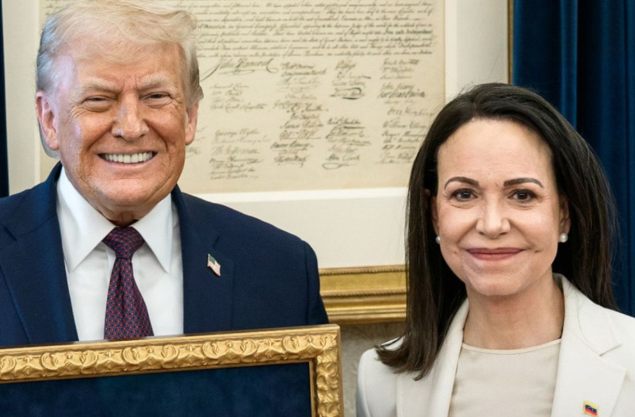
Machado’s decision to hand over the physical medal took place in the Oval Office, where photographs were taken of Trump holding the medal. Afterward, Machado confirmed that she had presented him with her Nobel Peace Prize medal as a symbolic gesture of respect and gratitude, expressing her belief that his commitment to freedom made him worthy of such recognition. Trump described the moment as an honor, thanked Machado publicly, and praised her courage and dedication in his remarks following the meeting.
In response to this symbolic exchange, the Nobel Peace Center clarified an important and often overlooked distinction about Nobel prizes. The Center emphasized that while a laureate may give the physical medal to someone else, the official status of being a Nobel Peace Prize recipient cannot be transferred, revoked, or shared with another person. Once the Nobel Committee announces a winner, that decision is permanent and remains tied to the original recipient, regardless of who holds the medal itself.
The Nobel Peace Center’s clarification followed similar comments from the Norwegian Nobel Committee, which oversees the award. According to officials, the statutes governing the Nobel Peace Prize make clear that awarding the prize and recognizing the official laureate is a final decision that cannot be altered by subsequent actions involving the medal. This means that although Trump may physically possess the medal, he is not officially a Nobel Peace Prize laureate, and the honor remains connected to Machado in the historical record.
This distinction is rooted in the long-standing rules of the Nobel Foundation, which have guided the administration of all Nobel prizes since their establishment. While past laureates have sometimes sold or donated their medals for symbolic or charitable reasons, the title of laureate is always anchored to the original recipient and appears in official documentation maintained by the Nobel institutions.
Machado has publicly expressed strong admiration for Trump’s actions, framing her gesture as a personal and symbolic expression of gratitude on behalf of the Venezuelan people. She has described his work in relation to Venezuela’s political transition as significant for justice, freedom, and human dignity. Her remarks followed a White House meeting where she highlighted what she views as historic progress, and she explained that presenting the medal was meant to reflect the connection she sees between his leadership and the democratic aspirations of her country.
Despite the symbolic nature of the handover, the Nobel Committee and Peace Center have made clear that the Nobel Peace Prize’s official status remains fixed with Machado. The rules governing the prize prioritize the integrity and permanence of the award process. In recent years, similar clarifications have reaffirmed that Nobel prizes are awarded based on a rigorous selection process and that subsequent actions involving the medal do not alter official recognition.
The situation has attracted considerable attention not only because of the unusual circumstances surrounding the meeting but also because of broader questions it raises about international honors, political symbolism, and the ways in which global awards are referenced in diplomatic and political contexts. Machado’s gesture has been discussed widely in the media and on social platforms, with commentators noting both the historical significance of the Nobel Peace Prize and the unique nature of her decision to present her medal in such a high-profile setting.
Machado’s support for Trump follows her own lengthy struggle for democratic reforms in Venezuela, a movement that brought her to international prominence and ultimately to receiving the Nobel Peace Prize. Her advocacy has centered on demanding free elections, democratic governance, and human rights protections in her home country, where authoritarian rule has long shaped political life and restricted civic freedoms.
While some observers have viewed the medal presentation as a personal tribute, others have highlighted the Nobel institutions’ emphasis on the permanence of title and the distinction between symbolic gestures and official recognition. According to the Nobel Peace Center, historians, scholars, and members of the public should understand that Nobel Peace Prize laureateship remains fixed with the original awardee, regardless of subsequent exchanges involving the physical medal.
In the end, the episode has underscored how deeply symbolic international prizes can be, how individual leaders use them in diplomatic contexts, and how award-granting institutions safeguard the integrity of their decisions. Whether through symbolic gestures or public praise, the legacy of the Nobel Peace Prize continues to generate discussion, debate, and reflection on peace, leadership, and global recognition.