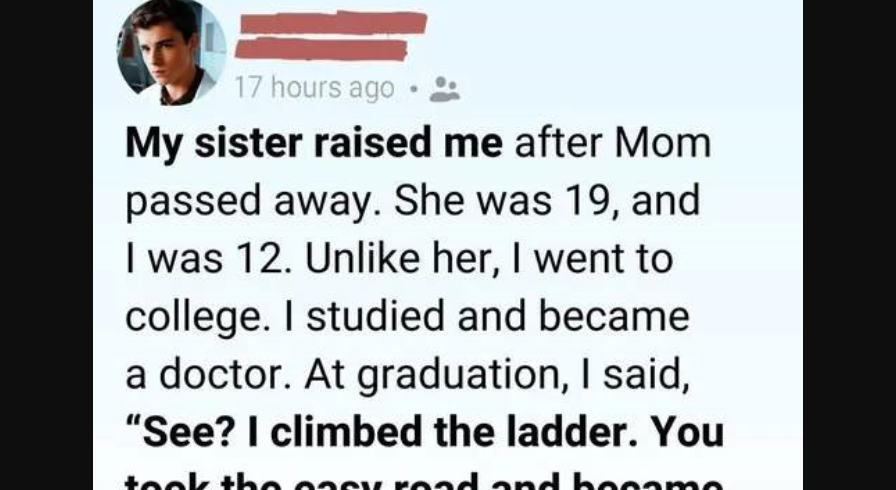
My mother died when I was twelve. What stayed with me most was not the sound of crying, but the quiet details—the sharp scent of antiseptic in the hospital and the way my sister stood at the funeral. Her back was straight, her chin slightly raised, as if she had decided that grief would not be allowed to bend her. She was nineteen.
That day marked a turning point I didn’t fully understand at the time. She stepped into a role far beyond her years and became the center of my world. Without making it known to others, she left college and took on two jobs. She learned how to turn a small grocery budget into meals that lasted the entire week. She carried responsibilities that most people her age had never faced.
What I remember clearly is the way she smiled. It was steady, reassuring, and strong enough to make me believe everything would be alright. Every time she said, “We’ll be fine,” I accepted it without question.
For a long time, it seemed true. I focused on my studies, determined to succeed in every possible way. School became my path forward, and I followed it with discipline. I moved from one achievement to the next—university, graduate school, and eventually a career that others admired.
At my graduation, standing in a formal gown and hearing applause, I searched for her in the crowd. She sat in the back row, clapping quietly, her expression filled with pride. It felt as though that moment belonged to her as much as it did to me.
When I reached her, I spoke with excitement, carried by the success I had worked toward. I told her I had made it, that I had reached the goals I set for myself. Then I said something I would come to regret deeply. I told her she had chosen an easier path and had ended up with nothing to show for it.
The words settled between us in a way I didn’t expect. She didn’t argue or respond with anger. She gave a small, tired smile and said, “I’m proud of you.” Then she walked away.
The Hollow House and the Silent Truth
Three months passed without contact. No calls, no messages. I convinced myself she needed time and that everything would return to normal. My life was full—new city, new job, new responsibilities. I stayed focused on moving forward.
During a trip back for a conference, I decided to visit her. The door was unlocked when I arrived. As I stepped inside, something felt off immediately.
The house felt empty. Furniture was missing, and the walls were bare where photos once hung. The space carried a quiet that felt unfamiliar. I followed a faint sound into the living room.
She was lying on the floor.
Her face was pale, her body weak, her breathing strained. She looked smaller than I had ever seen her, as though the strength I had always relied on had slowly faded. I rushed to her side, calling her name. Even then, she tried to reassure me with a faint smile.
“I didn’t want you to worry,” she said softly.
At the hospital, the truth unfolded piece by piece. She had been living with a chronic illness that had gradually worsened over time. There were treatments she couldn’t always afford and appointments she had skipped. The money she had been sending me—the support I believed came from something left behind—had come from her own sacrifices.
“There was no inheritance,” she told me quietly. “I wanted you to focus on your future without feeling burdened.”
The Price of an Expanded Life
As I sat beside her, everything began to make sense in a way that felt overwhelming. The missing furniture, the absence of personal belongings, even items that once held memories of our mother—all of it had been sold over time.
She had been reducing her own life so mine could grow.
Memories returned with new clarity. The long work hours, the quiet exhaustion behind her steady smile, the way she never allowed her struggles to show. Everything I had achieved had been supported by her quiet endurance.
That night, as she rested, I stayed awake, reflecting on everything I had overlooked. My understanding of success began to shift. I had measured it through achievements and recognition. She had measured it through care, responsibility, and unwavering support.
When she opened her eyes the next morning, I spoke with honesty I should have shown long before. I told her she had always been the reason I reached where I was. I told her she had never been without value. I apologized with a sincerity that was difficult to express in words.
“I’m here now,” I said. “You don’t have to carry this alone anymore.”
Greatness Without Applause
She held my hand, her expression soft, her eyes filled with emotion. The same quiet smile returned, though now I understood what it carried behind it.
In that moment, I realized something no achievement had ever taught me. True strength does not always draw attention. It exists in quiet actions, in steady support, and in the willingness to give without recognition.
Her care had shaped my future in ways I had never fully understood. It had given me opportunities, stability, and direction. More than that, it had shown me what genuine kindness and dedication look like.
That understanding stayed with me. It changed how I viewed success, how I valued others, and how I defined what truly matters.
Some of the most meaningful contributions in life happen quietly, without applause or acknowledgment. They hold everything together in ways that are not always visible. And sometimes, it takes time—and reflection—to truly see them for what they are.