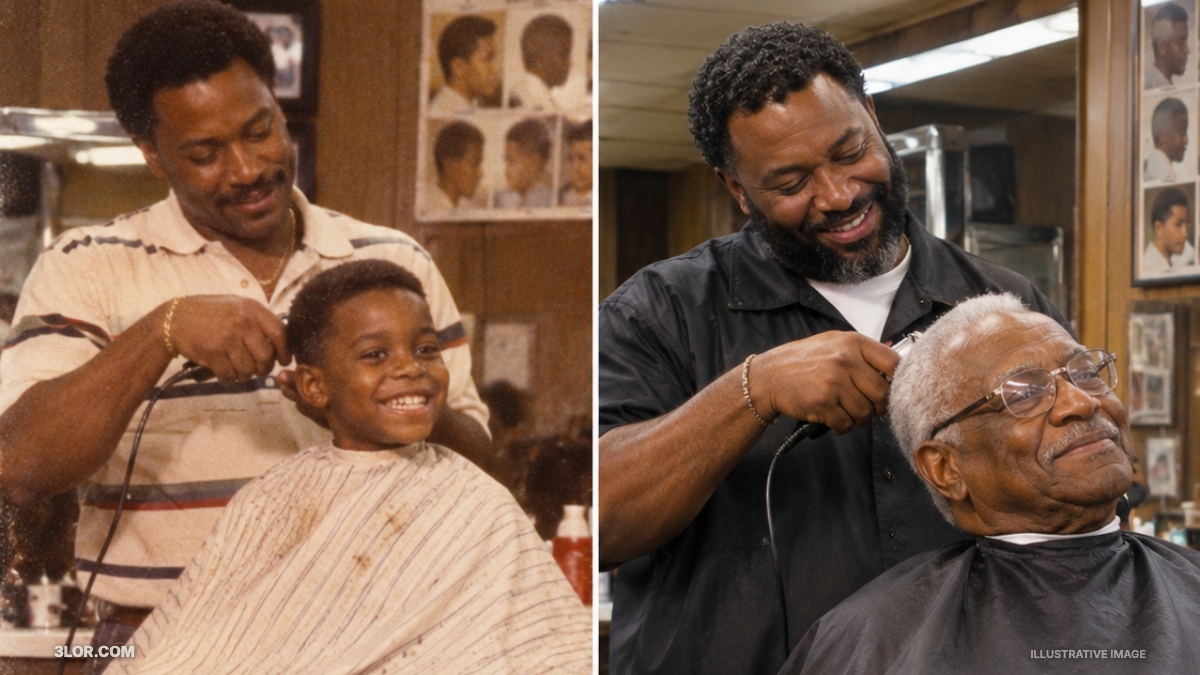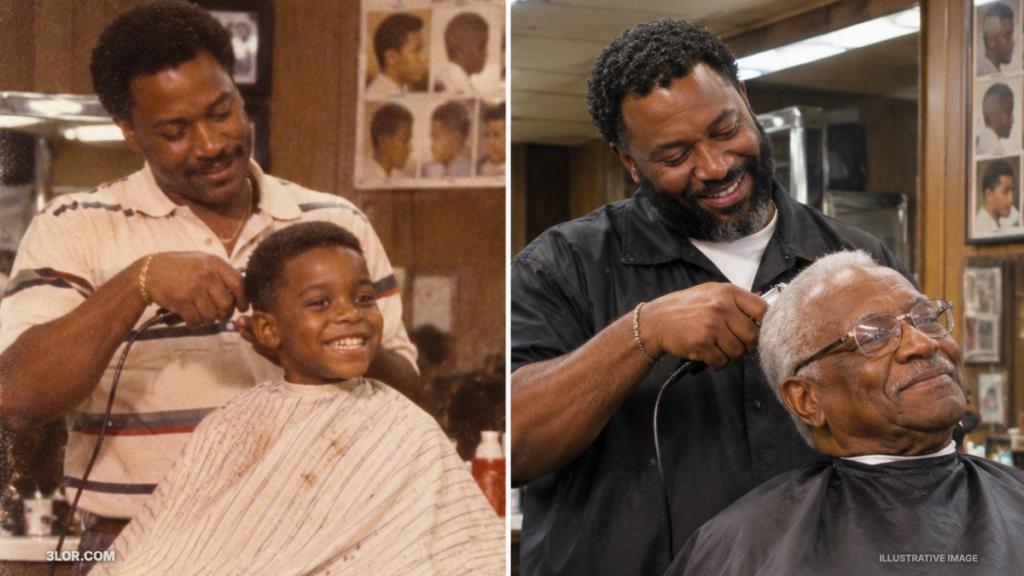
Daddy opened Walker’s Cuts on Lincoln Avenue in 1979. Two chairs, one radio that only got the gospel station on Sundays, and a poster on the wall showing every haircut a man could ever want. The sign in the window said “Walk-Ins Welcome.” The one by the register said “No Cussing. Mrs. Walker Is Listening.”
I grew up on a wooden board laid across the arms of chair number two.
Every Saturday, he’d tap the board and say, “Sit up straight, King. A man’s first impression starts at the neckline.”
He taught me how to hold the clippers when I was eleven. How to fade without leaving a line when I was fourteen. How to listen when a man sat down in your chair, because, he said, “Sometimes they don’t need a haircut, son. They need somebody to talk to.”
He was right. I watched grown men cry in that chair. I watched deacons argue about football, young boys get their first lineup before prom, and old men come in every week just to sit, because the shop was the only place they didn’t feel alone.
When I was nineteen, I told him I didn’t want to be a barber.
I wanted to go to college. I wanted to get out of Lincoln Avenue.
I expected a fight. He didn’t argue.
He just nodded, kept sweeping the floor, and said, “Then go. And don’t look back.”
I didn’t.
THE SCHOLARSHIP
I got into State on something called the Lincoln Avenue Community Scholarship. Full tuition, four years. I’d never heard of it before the letter came. My mother said the neighborhood churches funded it. I was too proud and too grateful to ask questions.
I graduated. I became an accountant. I moved six hours away, got married, had a son of my own.
For twenty years, I came home for Thanksgiving and Christmas, and I always let Daddy cut my hair. But I never picked up the clippers again.
Then last month, my mother called on a Tuesday night.
“Your daddy has surgery Friday. Triple bypass. He won’t tell you, but he’s scared.”
I drove six hours that night.
CHAIR NUMBER TWO
I found him at the shop at 10 p.m., alone, sitting in chair number two with half the lights off and the gospel station playing low.
He looked so small in that chair. I had never once seen my father look small.
“Son,” he said, holding out his old silver clippers. The same ones. “Give me the last one.”
“Daddy, don’t say that.”
“Just in case. Please.”
So I did.
My hands shook the whole time. I hadn’t held clippers in more than twenty years, but my fingers remembered everything he taught me. He watched me in the mirror and didn’t say a word.
When I finished, he ran his hand slowly across the back of his neck and smiled.
“No line,” he said. “I knew it.”
Then he stood up, walked to the old wooden drawer under the register, and pulled out a yellowed envelope.
My name was on the front, in his handwriting. Under it, a date: June 1991.
“I wrote this the week I gave you your first haircut,” he said. “I was supposed to give it to you the day you left for college. I couldn’t do it.”
He pressed it into my hand.
“Open it tomorrow. After surgery. Whatever happens.”
I didn’t wait until tomorrow. I opened it in the car, in the parking lot, under the streetlight.
THE LETTER
“King,
If you’re reading this, you’ve decided to go your own way. Good. That’s what I’ve been praying for since the day you were born.
Here’s what you don’t know. Every Saturday since you were seven, I’ve put one dollar from every haircut in a coffee can under this register. Not for the shop. For you.
By the time you read this, it’ll be enough for college. Your mother and I will tell you it’s a scholarship from the churches, because I know you, and you’ll never take it if you know it came from me.
Don’t come back here because you feel guilty. Come back because you want to. And if you never want to, that’s fine too.
I didn’t build this shop so you’d have to stand in it. I built it so you’d never have to.
Love,
Daddy
P.S. Keep your neckline clean. People notice.”
I sat in that car for an hour.
There was no Lincoln Avenue Community Scholarship. There never had been.
It was twelve years of dollar bills from a coffee can under a register. Every Saturday. Every haircut. Every man who sat down in that chair and needed somebody to talk to had paid for my education without ever knowing it.
FRIDAY
Daddy’s surgery took six hours.
I spent every minute of it in the waiting room, holding that letter.
When the doctor came out and said, “He did great,” my mother collapsed into my arms, and I cried harder than I had since I was a little boy on that wooden board.
The first thing Daddy said when he woke up, still groggy, was: “Did you read it?”
I nodded.
“Told you to wait,” he mumbled.
“You did a lot of things for me without telling me,” I said. “So I figured I was owed one.”
He laughed so hard the nurse told him to stop before he pulled a stitch.
SATURDAYS
Walker’s Cuts is still open on Lincoln Avenue.
Daddy’s doctor says he can’t stand for eight hours anymore. So now, every other Saturday, I drive six hours and I work chair number two. Daddy sits in chair number one, cuts a few heads, and tells every customer who will listen that his son is the best fade on the east side.
Last month, I brought my own son, Marcus, for the first time. He’s seven.
Daddy laid the old wooden board across the arms of chair number two and tapped it.
“Sit up straight, King Junior,” he said. “A man’s first impression starts at the neckline.”
There’s a new coffee can under the register now.
Marcus doesn’t know about it yet.
This story is a work of fiction. Names, characters, and events are products of the author’s imagination. Any resemblance to actual persons, living or dead, is purely coincidental.