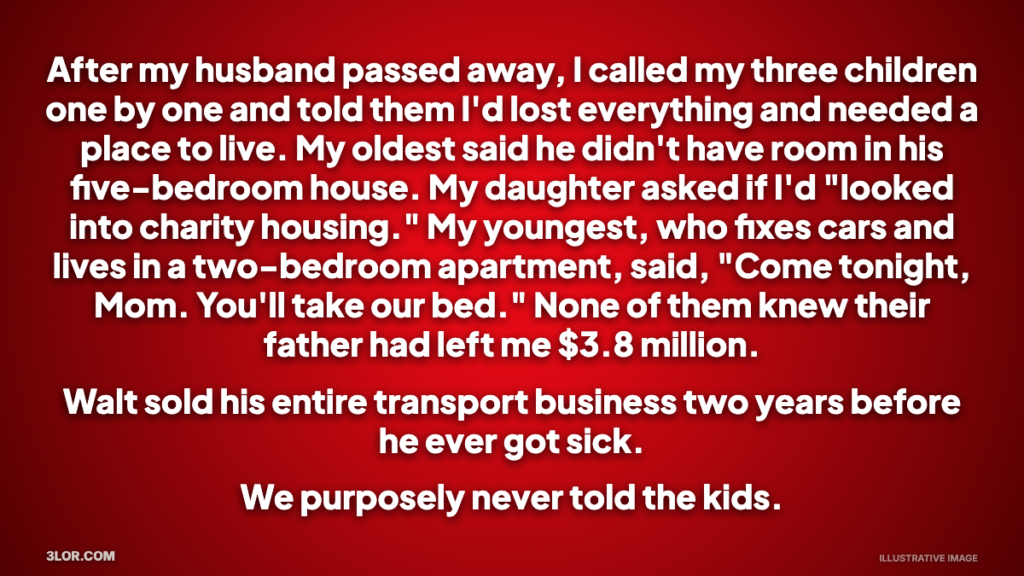
“Mom, can we just get to it? I have a dinner reservation at seven.”
Michael’s voice cut through the clatter of Danny’s small kitchen, sharp and dismissive. He stood with his back to the grease-stained counter, glancing down at his smartwatch. Beside him, Stephanie kept her cashmere coat drawn tight across her chest, her eyes darting between the cream envelope and the peeling wallpaper by the window.
Danny didn’t say a word. He was leaning against the doorframe, his forearms crossed, his work jeans held up by an old leather belt. Kayla was by the sink, quietly drying the plates we had just used for Thanksgiving dinner, keeping her eyes down.
I reached out and laid my hands flat against the Formica table.
“You have time for this, Michael,” I said. My voice was quiet, but it had the kind of weight that made him stop tapping his watch. “Your father spent forty years building a business so you wouldn’t have to worry about where your next meal came from. You can give him ten minutes.”
Michael frowned, but he stayed where he was.
Stephanie reached across the table, her manicured nails hovering over the white envelope with her name on it. “Can we open them now?”
“Go ahead,” I said.
Stephanie tore into hers first. Her fingers worked fast, ripping the paper edge without bothering to slide a finger under the flap. A single sheet of folded paper slipped out, followed by a small, tarnished silver coin.
She turned the coin over in her hand. It was an old transit token from 1984—one of the tokens Walt had carried in his pocket the day he bought his first used flatbed truck.
She unfolded the paper. Her eyes scanned the lines, and her eyebrows pulled together in confusion.
“What is this?” she asked, looking up at me. “A bill?”
“Read it out loud, Stephanie,” I told her.
She cleared her throat, sounding irritated. “‘To my daughter, Stephanie. Included is your share of the estate. Enclosed is the token that started my business, and an itemized receipt for the $84,000 paid toward your private boarding tuition, your wedding reception at the country club, and the down payment on your first condominium in Oak Park. You once told your mother that shelter was something community charities provide. I hope you never find yourself needing to test that theory. Love, Dad.’”
Stephanie’s face went dead white. The paper dropped from her fingers, landing face-up on the table.
“Where is the rest?” she whispered, her voice rising. “Where is the money? The equipment? The land by the depot? Dad had assets, Mom! He owned twelve trucks!”
Michael didn’t wait. He grabbed his white envelope, tore it open, and dumped the contents into his palm.
A metal key on a faded plastic tag fell out, clattering against the table.
He unfolded his note, his jaw clenching as he read silently. But I already knew every word Walt had written.
“Michael. You have five bedrooms, three bathrooms, and an empty guest room that you turned into a second office. Enclosed is the key to the front door of that house, which I co-signed and funded when you couldn’t secure the commercial mortgage twelve years ago. You told your mother to look into senior housing links. I am returning this key to you so you never have to worry about someone asking for space you aren’t willing to give.”
Michael’s fingers gripped the paper so tightly the corners tore.
He stared at me, his face flushing crimson under the fluorescent kitchen bulb. “Is this a joke, Mom? Did you bring us down to this dump on Thanksgiving to insult us?”
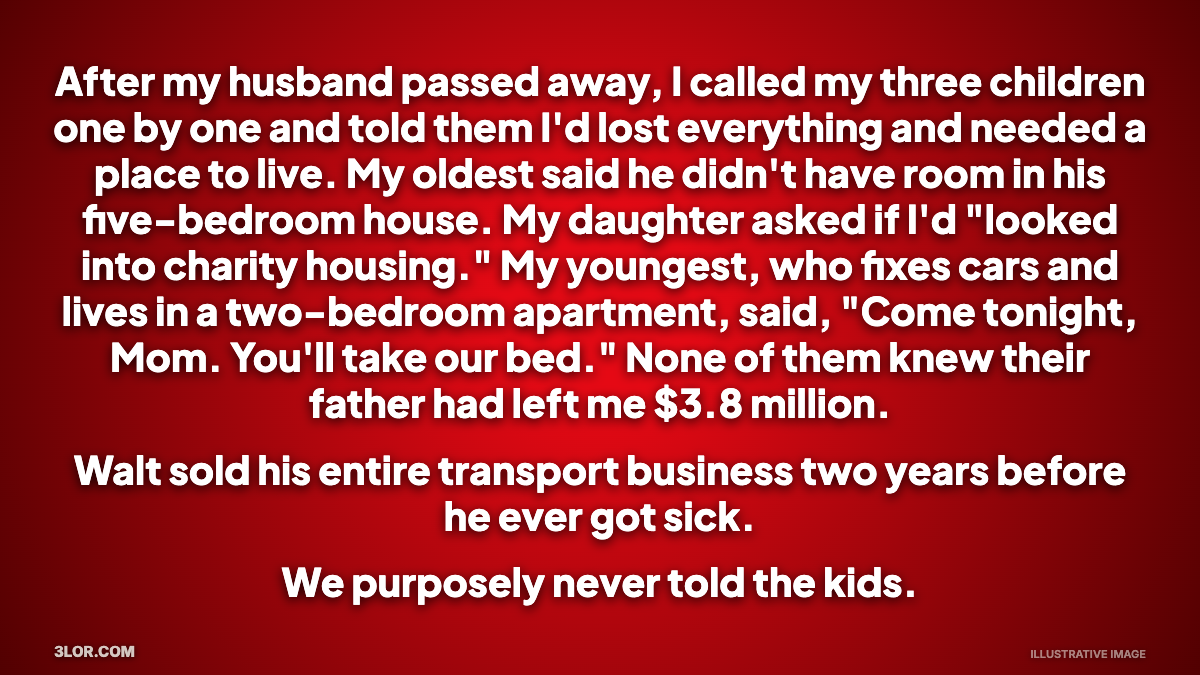
“You insulted yourselves, Michael,” I said, looking him dead in the eye. “Three months ago, when I called you from an empty house, you didn’t ask if I had groceries. You didn’t ask if I was warm. You sent me three links to subsidized apartments and went back to your dinner.”
I turned toward the doorframe where Danny was standing.
“Danny,” I said gently. “Take yours.”
Danny hesitated. He looked at Michael, then at Stephanie, who was staring at him with pure venom. He stepped to the table, his heavy boots scuffing the linoleum, and picked up the thick cream envelope with the red wax seal.
His hands were rough, calloused from sixty-hour weeks changing transmissions and handling rusted brake lines. He broke the wax carefully, sliding the heavy folded parchment out.
A brass set of safe-deposit keys slid into his palm, followed by a certified deed stamped with a gold corporate seal.
“Mom?” Danny’s voice was barely a whisper. “What is this?”
“Read it, son,” I told him.
Danny’s eyes moved slowly across the page. Halfway down, his hands began to shake. He looked up at me, his eyes wide and wet with tears, then turned his gaze toward Kayla at the sink.
“I… Mom, no,” he choked out. “This can’t be right.”
Michael lunged forward and snatched the document from Danny’s hand before I could stop him.
He scanned the legal text, his eyes darting frantically from line to line.
“A trust?” Michael’s voice cracked into pure hysteria. “The commercial property on Route 9? The accounts at Chase? Three point eight million dollars?!”
Stephanie gasped, leaping out of her chair so fast it knocked against the wall. “What did you say?!”
“Walt sold the transport company two years before he was diagnosed, Michael,” I said calmly, folding my hands over Walt’s old reading glasses. “He didn’t lose the business. We didn’t have unpaid hospital bills. We didn’t lose the house. We sold it all and placed every single dollar into an irrevocable family trust.”
Michael slammed the paper back onto the table, his hands trembling with fury. “You lied to us! You played games with your own children! That is fraud!”
“Your father wanted to know who would show up when there was nothing left to inherit,” I answered, my voice steady as stone. “He wanted to know who loved him for his hands, and who loved him for his wallet.”
I stood up from the folding chair.
“You had five bedrooms, Michael, and not six feet of floor space for the woman who carried you for nine months. You had thousands of dollars for tennis lessons and ski trips, Stephanie, but you suggested a homeless shelter for your mother.”
I looked at Danny, who was still standing frozen, holding the brass keys in his open hand.
“Your brother didn’t ask for a financial statement,” I continued. “He didn’t ask if there was a will. He got into his truck while he was still covered in grease, drove forty minutes across town, and gave me his own bed while he slept on a broken couch with a spring poking into his ribs for ninety days.”
Stephanie took a step toward Danny, her hands outstretched, tears finally spilling down her cheeks. “Danny… please. You know we were just overwhelmed. Dad’s death was hard on all of us. You wouldn’t cut your own brother and sister out of our father’s legacy, would you? We’re family!”
Danny looked at Stephanie. Then he looked down at the brass keys in his hand.
For ten years, Michael and Stephanie had treated Danny like the black sheep because he worked with his hands. They made jokes about his old truck at holiday dinners. They never invited his boys to their children’s birthday parties at the country club.
Danny slowly pulled his hand back, closing his fingers tightly around the keys.
“Dad’s legacy wasn’t the money, Steph,” Danny said, his voice thick but firm. “Dad’s legacy was showing up. And neither of you ever did.”
Michael grabbed his coat from the back of the chair, his face dark with bitter defeat. “Enjoy the garage, Danny,” he spat. “Let’s see how long that money lasts you.”
He grabbed Stephanie’s arm and yanked her toward the front door.
They didn’t say goodbye to their mother. They didn’t look at their nephews, who were peeking out from the bedroom hallway in their pajamas. The heavy wooden door of the apartment slammed shut behind them, the vibration rattling the cheap plastic blinds on the window.
The kitchen went completely quiet.
Kayla walked over from the sink, tears streaming down her face, and wrapped both arms around Danny’s neck. Danny buried his face in her shoulder, his chest heaving with silent, deep sobs as thirty years of feeling like the forgotten child finally broke open.
I walked over, placed my arm around both of them, and rested my head against Danny’s shoulder.
“Pack your things tonight, kids,” I said softly, smiling through my own tears. “Tomorrow morning, we’re going to look at the house on the hill Walt picked out before he left. It has four bedrooms, an acre of grass for the boys, and a three-car garage with a hydraulic lift.”
Danny looked at me, his eyes red, and smiled for the first time in three months.
“Does it have a good bed, Mom?”
“The best in the world, honey,” I whispered. “And it’s all yours.”
Editorial Note: This account is presented as an elite-level narrative case study examining testamentary freedom, conditional trust structures, and familial estate disputes under private probate governance. All personal names, administrative entities, and specific municipal jurisdictions have been modified to protect the privacy and legal records of the individuals involved.