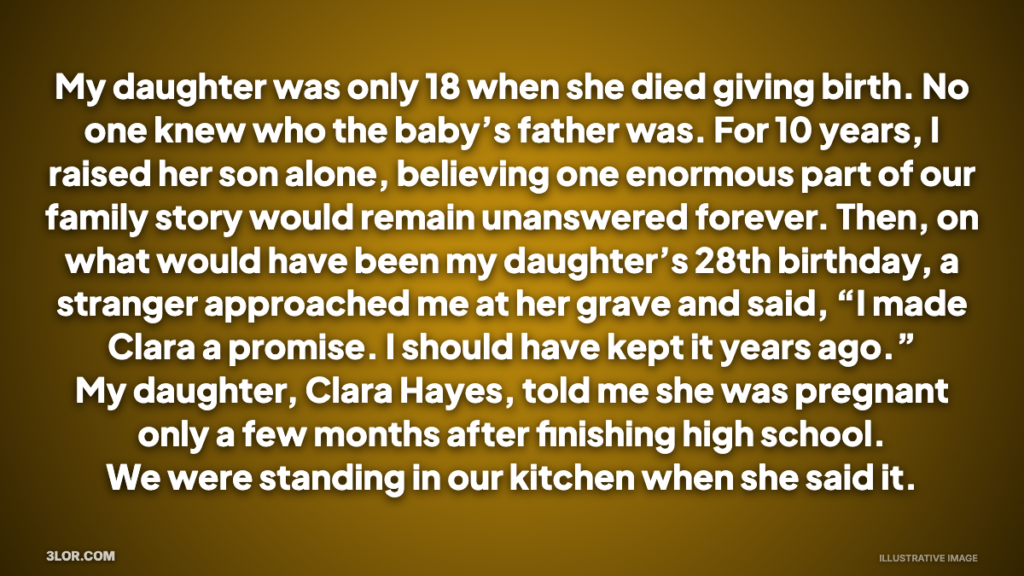
“Who is his father?”
Eleanor Sterling didn’t answer immediately. She couldn’t. She stood frozen on the damp November grass, her gloved hand still pressed against her mouth, staring at Leo as he jogged up the hill holding a folded piece of blue construction paper.
Leo slowed down as he reached us, his eyes darting from the stranger’s wet cheeks to my rigid posture.
“Grandma?” he asked, slipping his small hand into mine. “Is everything okay?”
“Go put your card by your mom’s stone, sweetheart,” I said, keeping my voice as steady as I could. “I’ll be right there.”
Leo hesitated, glanced once more at Eleanor, and walked over to the granite headstone. He knelt down, carefully placing the yellow flowers and his handmade card beside the engraved dates.
The moment he was out of earshot, I turned back to the woman in the charcoal coat.
“I’m going to ask you one more time,” I said quietly. “How do you know my daughter’s name, and why are you looking at my grandson like that?”
Eleanor wiped her eyes with the back of her wrist, taking a shaky breath.
“My son’s name is Julian,” she whispered. “Julian Sterling.”
The air left my lungs.
Julian. The single word written on the scrap of paper I had found in Clara’s hospital bag ten years ago. The name I had given Leo as his middle name so he would carry at least one piece of his father with him.
“Where is he?” I asked, a sudden, sharp anger cutting through my shock. “Clara was eighteen years old. She died in a delivery room outside Seattle while I held her hand alone. Where was Julian?”
Eleanor’s shoulders sagged. She looked ten years older in the span of three seconds.
“He was in a coma at Harborview Medical Center,” she said, her voice breaking. “Four days before Clara went into labor, Julian’s car hit black ice on I-90 coming back from a shift in Bellevue. He didn’t wake up for three months.”
The Truth Behind the Silence
We sat on a stone bench twenty yards from Clara’s grave while Leo sat cross-legged by his mother’s headstone, carefully straightening the petals of the yellow flowers.
Eleanor didn’t ask for forgiveness. She just laid the whole truth out on the cold stone between us.
Julian had been twenty-one, working two jobs to put himself through an engineering program while saving for an apartment. When Clara told him she was pregnant, he hadn’t run. He had brought her home to meet his parents—and that was where the “family problems” Clara had mentioned to me had started.
Eleanor’s husband, Richard Sterling, was a partner at a mid-sized commercial real estate firm in Seattle. He had big, rigid plans for his only son, and an eighteen-year-old girlfriend from a working-class town outside the city didn’t fit into them.
“Richard told Julian that if he didn’t walk away from Clara, he’d cut him off completely—no tuition, no car, no health insurance,” Eleanor said, staring down at her gloved hands. “Julian told my husband to go to hell and packed his bags that night. He swore he’d marry Clara as soon as she turned nineteen.”
“Then why didn’t Clara tell me?” I asked. “I would have helped them.”
“Because Richard threatened to file for custody if she didn’t stay quiet,” Eleanor admitted, tears spilling over again. “He told her he’d hire the best lawyers in King County, claim she was an unfit teenage mother with no income, and take the baby away. Clara was terrified of losing her son. She made me promise—the week before the car accident—that if anything happened, I wouldn’t let Richard near the baby.”
When Julian’s car slid off the highway, everything collapsed.
By the time Julian woke up from his coma three months later, his memory of the accident was fragmented, and Richard had already moved the family to Spokane for a “fresh start.” Richard told his recovering son that Clara had moved away to California with her mother and wanted nothing to do with him.
“I knew the truth,” Eleanor whispered. “I knew Clara had passed away. I came to her funeral and stood by the trees at the back of the cemetery so you wouldn’t see me. I kept my promise to keep Richard away, Martha. I told myself the boy was safer with you.”
“And Julian?” I asked.
“Richard died of a stroke four months ago,” Eleanor said, looking up at me with red-rimmed eyes. “When we cleaned out his office, Julian found the private investigator’s folder my husband had kept locked in his safe. Everything was in it—Clara’s obituary, the hospital record, and a photograph of Leo taken outside his elementary school two years ago.”
The Man in the Parking Lot
My heart hammered against my ribs. “Julian knows?”
Eleanor nodded slowly, gesturing toward the bottom of the hill, near the iron gates of the cemetery.
Parked thirty yards behind my old Subaru was a dark blue Ford pickup truck. A man was leaning against the driver’s side door, his hands shoved deep into the pockets of his jacket, staring up the hill toward us.
Even from that distance, I recognized the jawline. I recognized the thick, dark hair and the exact way he tilted his head.
It was Leo’s face, twenty years older.
“He drove straight through the night from Spokane,” Eleanor said softly. “He wouldn’t come up the hill without your permission. He’s been standing down there for twenty minutes, terrified that if he walks up here, he’ll ruin the only life his son knows.”
I looked back at Leo.
He had finished arranging the flowers and was walking back toward the bench, wiping grass stains off his jeans. He looked at Eleanor, then at me, sensing that something enormous had shifted in the cold November air.
“Grandma?” Leo asked. “Who is that lady?”
I looked down the hill at the man waiting patiently by the truck, then back at the boy who had asked me every year since he was six if his father had simply thrown him away.
I knelt down in front of Leo, resting my hands on his shoulders.
“Remember how I always told you that your mom loved you, and that there was a part of the story I didn’t know?” I asked gently.
Leo nodded, his eyes wide.
“That’s your grandmother, Eleanor,” I said, nodding toward the woman on the bench. “And the man standing by the blue truck down there… his name is Julian. He didn’t abandon you, Leo. He’s been looking for you.”
Ten Years Late, Right on Time
We didn’t rush it.
Julian didn’t sweep Leo off his feet or demand anything. When he finally walked up the hill after I waved him over, he stopped six feet away, his eyes glistening, his hands trembling slightly as he crouched down to Leo’s eye level.
“Hey, Leo,” Julian said, his voice hoarse. “I’m… I’m really glad to finally meet you.”
Leo stood stiffly beside me for a long moment, studying the stranger’s face. Then, quietly, he pointed down at the small silver watch on Julian’s wrist.
“Does that come apart?” Leo asked. “I like taking things apart with screws.”
Julian let out a wet, surprised laugh, wiping his face with his sleeve. “Yeah, buddy. Actually, I’m an engineer. I’ve got a whole toolbox in the truck.”
We didn’t solve ten years of grief in one afternoon. There were lawyers to call, birth certificates to amend, and a lot of painful conversations waiting for us over hot coffee at a diner off I-5.
But as I watched my grandson walk down the cemetery hill beside the father who had spent three months in a coma and ten years in the dark, I looked back once at Clara’s headstone.
The yellow flowers were bright against the gray stone. For the first time in a decade, the silence around her grave didn’t feel unfinished.
Editorial Note: This story was written with AI assistance. All names, places, and details have been changed to protect the privacy of the people involved.