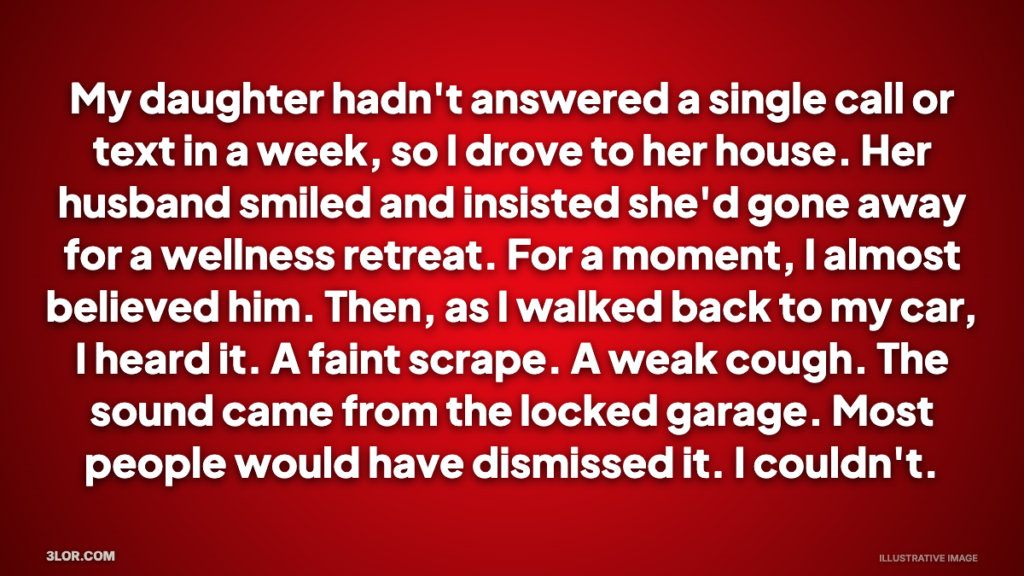
Seconds later, a sharp, deliberate tap-tap-tap echoed against the inside of the metal garage door.
It wasn’t an animal. Animals don’t knock in a steady rhythm of three.
I didn’t waste time rattling the brand-new padlock or shouting through the wood. Thirty-four years in a courtroom had taught me that if you tip off a man like Nolan Pierce before you have backup, he will find a way to control the narrative before the sirens even turn onto the street.
I backed quietly into the rain-slicked alley, pulled out my cell phone, and dialed 911.
“911, what’s your emergency?”
“My name is Elaine Harper,” I said, keeping my voice low and steady beneath the sound of the rain hitting my umbrella. “I am a retired senior prosecutor. I am standing in the alley behind 418 Sycamore Lane. My daughter, Rachel Pierce, has been missing for seven days. Her husband just told me she is at a wellness retreat, but I can hear her knocking and coughing inside a padlocked detached garage with no ventilation. Send patrol units and an ambulance immediately. Tell them not to use sirens until they turn onto Sycamore.”
I didn’t hang up. I stayed on the line with the dispatcher, watching the back of the white house through the dark.
Five minutes later, the back porch light flickered on.
Tessa stepped out onto the covered patio wearing Rachel’s blue cardigan, holding a plastic grocery bag. She walked down the steps toward the garage, unlocked the heavy padlock with a small brass key, and slipped inside, pulling the door shut behind her without locking it.
I didn’t wait for the cruisers.
I stepped out of the alley, crossed the wet grass, and pulled the garage door wide open.
Behind the Padlock
The air that hit me was thick, stale, and smelled faintly of damp concrete and bleach.
Tessa spun around, dropping the grocery bag—a half-empty bottle of water and a single sleeve of saltine crackers spilled onto the floor.
In the far corner, sitting on a folded moving blanket beside a stack of winter tires, was my daughter.
Rachel was pale, wrapped in an old wool coat, her wrists raw and red where zip-ties had clearly been cut away only recently—or replaced with a heavy chain looped around the steel support post of the workbench.
“Mom!” Rachel gasped, her voice hoarse and barely above a whisper.
“I’m right here, sweetheart,” I said, stepping straight past Tessa, who froze against the wall like a deer caught in headlights.
I knelt beside Rachel, wrapping my coat around her shivering shoulders. “The police are thirty seconds away. You’re safe.”
“Elaine, wait—” Tessa stammered, backing toward the open doorway. “You don’t understand. Nolan said she was having a psychotic episode! He said she was going to hurt herself if we didn’t—”
“Save it for the detectives, Tessa,” I said without looking up.
At that exact moment, red and blue lights painted the wet siding of the house as two patrol cruisers pulled silently into the driveway, blocking Nolan’s sedan.
The Prosecutor’s Trap
The front door of the house flew open. Nolan stepped onto the back porch, his practiced, charming smile completely gone, replaced by a flash of pure panic when he saw the uniformed officers fanning out across his lawn.
“Officers!” Nolan called out, instantly shifting back into his calm, reasonable persona. “Thank God you’re here! My mother-in-law is trespassing on my property, and my wife has been experiencing a severe mental health crisis—”
“Step down from the porch with your hands visible, Mr. Pierce,” the lead officer ordered, resting a hand on his belt. “We have a paramedic unit coming up the drive to evaluate your wife.”
Within ten minutes, Rachel was wrapped in a thermal blanket inside the back of the ambulance, sipping water while a female officer photographed the heavy chain bolted to the workbench, the bucket in the corner, and the padlock.
Tessa folded before they even reached the precinct. Sitting in the back of a patrol car, terrified of being charged as an accessory to kidnapping, she told the detectives everything.
She admitted that Nolan had discovered Rachel was planning to file for divorce and move back to my house after finding out he had drained $45,000 from their joint savings to cover his online gambling debts. When Rachel confronted him a week ago, Nolan had taken her phone, called her office to put her on “personal leave,” and locked her in the garage until she agreed to sign a post-nuptial agreement waiving all claims to the house and his retirement account.
He hadn’t expected me to drive four hours in the rain. And he certainly hadn’t expected me to recognize the tiny white flowers I had embroidered on my daughter’s cardigan.
The Quiet Drive Home
Nolan Pierce was arrested that night on felony charges of unlawful imprisonment, domestic battery, and financial coercion. Tessa was booked on felony conspiracy charges.
Two days later, after a brief stay at the hospital for dehydration, Rachel sat in the passenger seat of my car as we pulled out of the driveway of that small white house for the last time.
She was wearing her own faded blue cardigan—clean, washed, and smelling like cedar.
As we merged onto the highway heading back toward my town, she leaned her head back against the headrest and closed her eyes.
“How did you know to wait?” she asked softly.
I kept my eyes on the road ahead, where the rain had finally cleared into a bright, cold morning.
“Because I’m your mother, Rachel,” I said. “And I know the difference between a woman who wants privacy and a woman who’s asking for help.”
Editorial Note: This story was written with AI assistance. All names, places, and details have been changed to protect the privacy of the people involved.