Stephanie’s manicured finger hovered over the table.
Two of the envelopes were thin, standard white business stationery—barely heavier than a utility bill. The third, resting directly in front of Danny’s plastic plate, was thick, heavy manila, sealed with a crimsonwax-style sticker from a downtown estate law firm.
“Why is Danny’s so thick?” Stephanie asked, her voice losing the syrupy warmth she had used since walking through the door.
“Go ahead and open them,” I said, folding my hands in my lap. “Your father wanted everyone to have their share before the pie gets cold.”
Michael didn’t wait. He tore open his white envelope with a sharp rip, pulled out a single folded sheet of paper, and frowned.
Stephanie opened hers a second later. The color drained from her cheeks so fast I half-expected her to drop her wine glass.
“What is this?” Michael demanded, holding the paper up toward the ceiling light. “Mom, is this some kind of joke?”
It wasn’t a joke.
Inside Michael’s envelope was a printed copy of the exact email he had sent me three months earlier—the one with three links to subsidized senior apartments, with no personal note attached. Paper-clipped to the back was a certified notice from Walt’s estate attorney, stating that Michael had been formally excluded from the remainder of his father’s estate, save for a statutory one-dollar bequest.
Inside Stephanie’s envelope was a printed brochure for the community-run shelter she had suggested over the phone, accompanied by the exact same legal notice.
“I don’t understand,” Stephanie stammered, her eyes darting between me and the paper. “You said there was no money. You said the bank took the house.”
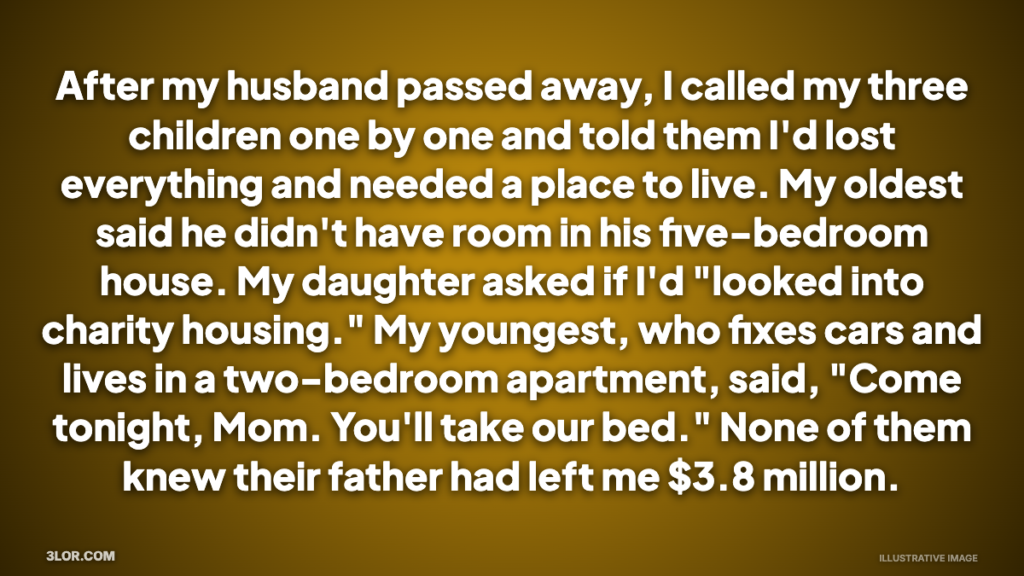
“I said I wanted to find out who my children were,” I replied evenly. “Your father sold his transport business two years before he passed. After taxes and medical bills, he left me $3.8 million.”
The Silence in the Kitchen
The cramped living room went dead quiet, save for the faint rumble of the laundromat dryers humming through the floorboards beneath us.
Michael’s jaw dropped. “Three point eight million?”
“And you let us think you were broke?” Stephanie’s voice cracked, rising into a shrill pitch. “You lied to us! You let me cry on the phone thinking you were going to be homeless!”
“You stopped crying the second I told you there was no money left, Stephanie,” I said quietly. “Then you asked me if I’d looked into shelters because you had to get to tennis practice. And Michael—you told me your guest room was Jenna’s home office. You sent me three website links and didn’t call me for six weeks.”
“We have responsibilities, Mom!” Michael snapped, tossing the paper onto the table. “You can’t just test your own kids like we’re lab rats! If you had told us Dad left you money, we would have made room! We would have figured something out!”
“That’s the point, Michael,” I said, looking him straight in the eye. “You only had room for me if I could pay my way.”
I turned toward my youngest son, who hadn’t even touched his envelope yet. He was sitting in his faded flannel shirt, looking back and forth between his siblings and me with genuine confusion.
“Open yours, Danny,” I said softly.
Danny slowly peeled back the flap of the thick manila envelope and pulled out two heavy, embossed documents.
The first was a paid-in-full warranty deed for a four-bedroom brick house twenty minutes outside of town—complete with a fenced-in backyard for the boys and a detached, heated two-car garage.
The second was a commercial lease-purchase agreement for the very auto repair shop where Danny had been working sixty hours a week, along with a certified check to cover the first five years of operating capital.
Kayla, sitting beside him, covered her mouth with both hands as tears spilled over her lashes.
“Mom…” Danny whispered, his voice hoarse. “Mom, I can’t take this. We didn’t—I just wanted you to have a bed.”
“You gave me your bed for ninety-two nights without asking for a dime, Danny,” I told him, reaching across the table to cover his grease-stained knuckles with my hand. “You and Kayla slept on a broken couch so I could sleep in peace. Your father always said money shows you who people are. You showed me.”
Closing the Door
Michael stood up so fast his folding chair clattered backward against the wall.
“This is ridiculous,” he muttered, grabbing his wool coat off the back of the sofa. “Come on, Jenna. We’re leaving. Enjoy your little charity project, Mom.”
Stephanie didn’t even look at me. She snatched her purse, shot Danny a glare sharp enough to cut glass, and followed Michael out the narrow apartment door without saying goodbye.
The door clicked shut.
For a moment, nobody spoke. Then Danny’s oldest boy, six-year-old Tyler, poked his head out from the hallway.
“Grandma,” he asked, holding up a plastic dinosaur, “are they mad because there’s no more turkey?”
Kayla let out a wet, startled laugh, wiping her cheeks with the back of her wrist.
“No, buddy,” Danny said, pulling his son onto his lap and wrapping one arm around his shoulders. “They just had to get home. Come on—let’s cut the pumpkin pie.”
I leaned back in my chair, looking around the tiny, warm apartment that smelled like roasted turkey and cinnamon. For the first time since Walt’s funeral, the ache in my chest finally went quiet.
Editorial Note: This story was written with AI assistance. All names, places, and details have been changed to protect the privacy of the people involved.