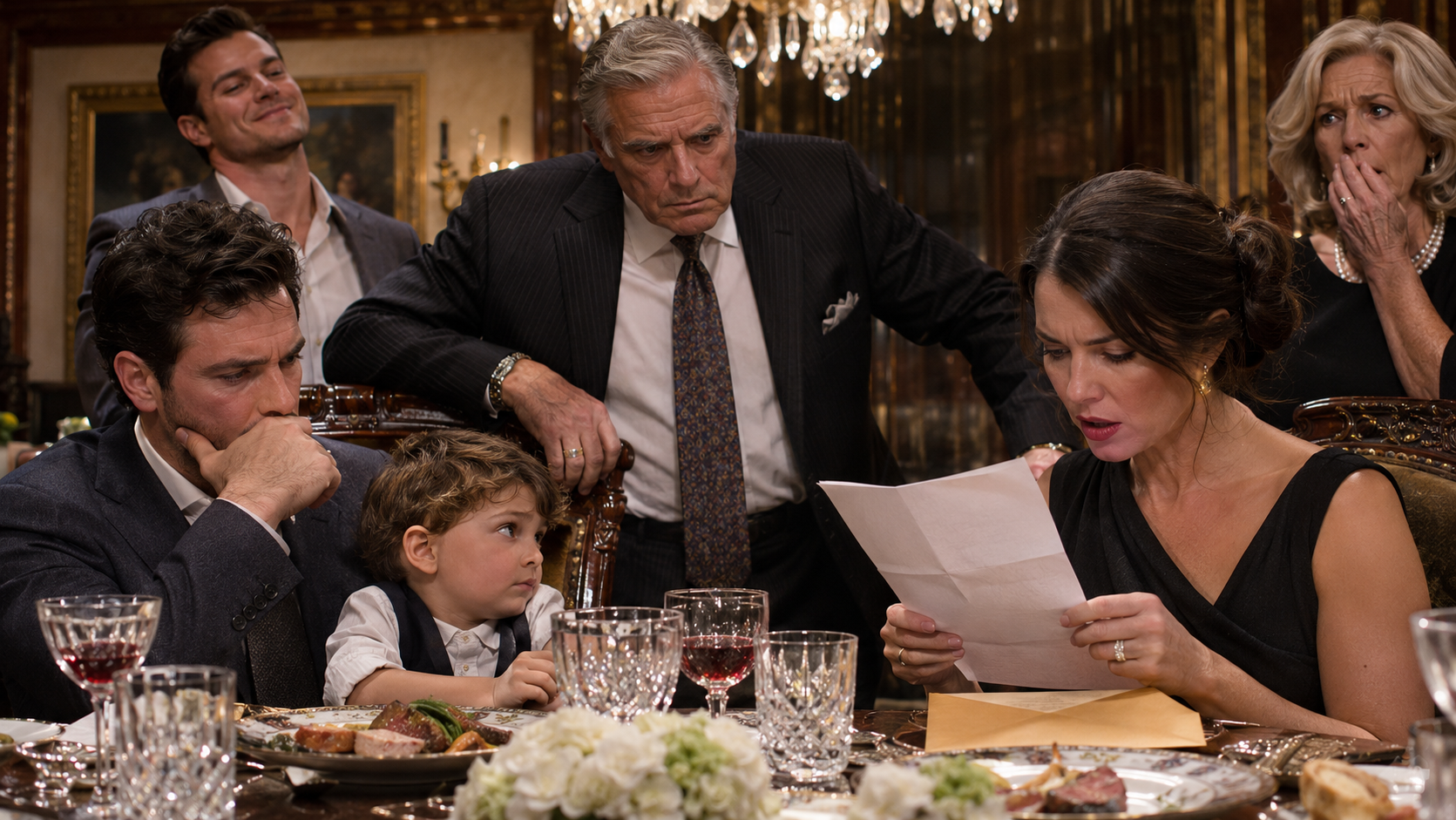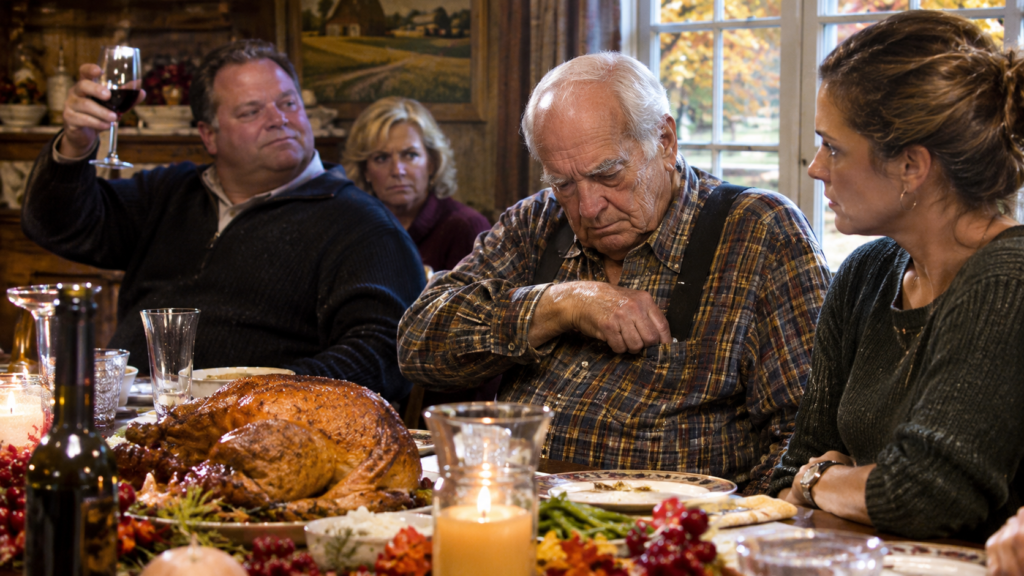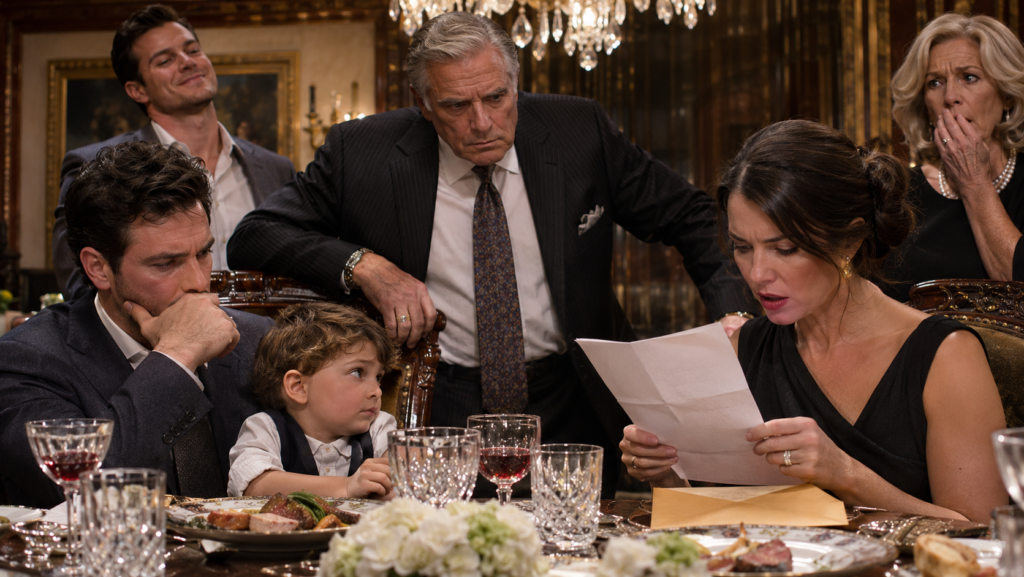
Beneath the crystal chandelier of his sprawling Denver dining room, sixty-five-year-old real estate developer Harlon Atwood waited until the catering staff had cleared the steak plates and pulled the heavy oak doors shut before sliding a thick manila envelope across the polished mahogany toward my wife, Daphne.
“I will not let my empire bleed for a child who doesn’t belong in this bloodline,” Harlon announced, folding his arms with the calm certainty of a man who had spent forty years buying his way out of consequences. Across the table, my younger brother, Dexter, leaned back in his chair with a practiced smirk, while my mother, Greta, stared down at her untouched wine glass as though she were bracing for an explosion.
Harlon expected tears, stammering denials, and an immediate divorce filing. What he didn’t know was that I had already seen the Crestwood Genetics receipt on his iPad two weeks earlier—and that by uploading my four-year-old son’s genetic profile onto a public ancestry database in a desperate hunt to frame my wife, my father had accidentally exposed a thirty-year-old secret of his own.
At thirty-four, I had spent my entire adult life putting distance between my architectural practice and Atwood Development. Unlike Dexter, who collected a six-figure sinecure at the firm and parroted every cruel joke our father made, I had paid my own way through graduate school and built an independent studio in LoDo. Harlon had never forgiven me for refusing to take his money—or for marrying Daphne, a brilliant graphic designer raised by a machinist and a school nurse in Pueblo.
From our very first dinner together, Harlon treated Daphne like an intruder. When our son, Calvin, was born four years ago with my square jawline and his maternal grandmother’s bright green eyes—breaking the Atwood pattern of dark hair and brown eyes—my father treated the child’s eye color like a forged signature. At Calvin’s third birthday party, Harlon had refused to even pick the boy up, remarking loudly enough for the neighbors to hear that nobody in the Atwood bloodline had green eyes. I had ordered both Harlon and Dexter off my property that afternoon and kept strict distance ever since.
Two weeks before Sunday dinner, however, Harlon asked me to stop by his office to troubleshoot a syncing issue on his tablet while he was out at the country club. While clearing his browser cache, an automated receipt from Crestwood Genetics popped onto the screen, confirming that a hair-follicle sample for Calvin Atwood had been processed and uploaded to a public genetic-genealogy portal.
A cold wave hit my chest as I remembered the brief, supervised visit Daphne had reluctantly allowed at Harlon’s estate the month before—and the jagged, coin-sized patch of missing hair behind Calvin’s left ear that Harlon had blamed on stray chewing gum and kitchen scissors.
Instead of confronting him on the spot, I photographed the billing statements, the laboratory chain-of-custody logs, and the public genealogy dashboard still logged in on his tablet—where Harlon had run a relative-matching search hoping to link Calvin to another man. What popped up at the top of the screen wasn’t an affair partner of Daphne’s. It was a direct maternal-line and half-sibling match that made my hands go numb on the steering wheel.
I drove straight to Piper Vance, the litigation attorney who handled my firm’s contracts. After reviewing the unauthorized collection of a minor’s biometric data and the genealogy records, Piper advised me not to tip him off. If I confronted Harlon privately, he would bury the records behind non-disclosure agreements and blame a clerical error. Better to let him stage his Sunday performance in front of witnesses.
That evening, Daphne and I sat at our kitchen table, laid out every printout, and planned our exact move.
Which was why, when the paper seal of Harlon’s envelope tore open in the quiet Denver dining room, Daphne didn’t flinch. Wearing a tailored black dress and deep crimson lipstick, she smoothed the Crestwood Genetics report flat against the wood, scanned the first page, and then turned deliberately to the second sheet—the public ancestry printout Harlon had tucked behind the paternity summary without reading the fine print.
Daphne looked up at my father, then across at me, before speaking in a clear, unhurried voice that carried to every corner of the room.
“Well, Harlon,” Daphne said, tapping the top line of the laboratory report with one manicured finger. “You got one thing right. Silus is ninety-nine-point-nine-nine percent confirmed as Calvin’s biological father. Your grandson’s green eyes came from my mother’s side of the family, which any tenth-grade biology textbook could have told you.”
Dexter’s smirk faltered. “Wait—what? No, Dad said the test proved—”
“Your father didn’t bother reading past the raw allele chart before uploading Calvin’s DNA to an open ancestry database to hunt for my supposed lover,” Daphne continued smoothly, turning the second page toward the center of the table. “Which is unfortunate for him, because the database automatically flagged a twenty-nine-year-old woman living in Boulder who shares twelve-and-a-half percent of Calvin’s DNA. That makes her Calvin’s half-aunt—and Silus’s biological half-sister.”
The grandfather clock out in the foyer ticked loudly in the dead silence. Greta’s hand flew to her mouth as she stared at her husband.
“What is she talking about, Harlon?” my mother whispered, her voice trembling.
Harlon’s tanned face went the color of wet ash. “That’s—that’s a database error. Those consumer sites are garbage—”
“It isn’t an error,” I said quietly, reaching inside my suit jacket and pulling out the certified birth and property records Piper had pulled from Boulder County two days earlier. “Her name is Maya Lindqvist. Her mother worked as an executive assistant at Atwood Development in 1996. According to county property deeds, you bought them a townhouse on Mapleton Hill in cash the year she was born and wired four thousand dollars a month into a custodial trust until Maya turned twenty-one.”
Harlon pushed his chair back so hard it scraped violently against the parquet floor, his composure shattering in front of his wife and both sons. “Silus, put those papers away right now! Greta, listen to me—that was thirty years ago, it meant nothing—”
“Don’t bother explaining it to me,” Greta said, standing up slowly and laying her linen napkin beside her plate. Her voice was ice. “Explain it to my divorce attorney on Monday morning. Thirty years, Harlon. And you had the nerve to sit at this table and lecture Daphne about loyalty and bloodlines.”
Harlon looked frantically from Greta’s retreating back to the folder in my hand, his chest heaving as he realized what was coming next. “Silus, son, wait—if you take that lab receipt to the police or the press, the state licensing board will suspend my development permits. Everything I built will collapse. Please—we’re family. Don’t destroy my life over a mistake.”
I stood up, reached across the table to pick up the Crestwood Genetics report bearing my four-year-old son’s name, and folded it neatly into my pocket.
“You cut hair off a four-year-old boy while he was sleeping in your house and tried to ruin his mother’s life over Sunday dinner,” I told him, resting a hand gently on Daphne’s shoulder. “Piper already filed the civil complaint for unlawful biometric collection of a minor and invasion of privacy with the district court on Friday. You won’t be seeing Calvin again—and you can settle the rest with my mother’s lawyers.”
Daphne and I walked out through the double oak doors into the crisp Colorado evening without looking back, leaving Harlon standing alone beneath his chandelier in a house that was already half-empty.
Editorial Note: While inspired by real-life family conflicts and modern genetic-testing privacy disputes, this story is a work of creative fiction written for entertainment purposes. Names, characters, and specific events have been dramatized.