At 7:15 on a Tuesday morning, seventy-three-year-old Dorothy was sitting at her kitchen table waiting for her chamomile tea to cool when her daughter-in-law’s name flashed across her phone screen. Expecting a medical emergency involving her twin grandchildren, Dorothy answered immediately—only to hear the low hum of highway tires, a morning radio broadcast, and Alicia’s voice carrying clearly from inside a moving car.
For nineteen unbroken minutes, Alicia never realized the call had connected. And Dorothy never said a word.
Instead, remembering the habit her late husband, Raymond, had drilled into her over forty-six years of marriage—when it matters, write it down—Dorothy pulled a magnetic grocery notepad across the oilcloth, clicked her ballpoint pen, and logged every detail with timestamps as her son, Mark, and his wife drove straight toward her house.
Every Sunday at five o’clock, Mark called Dorothy for a punctual eleven-minute check-in, while Alicia habitually referred to her as “Mother D” in a syrupy tone that never quite reached her eyes. Through the open line, however, the sweetness was gone. Alicia confirmed that Mark had brought a manila folder on the back seat and a glossy brochure from the glovebox for a facility called Silver Meadows, where Alicia’s cousin worked in admissions and had promised a “family discount.” When Mark hesitated briefly over how fast they were moving, Alicia dismissed him, reminding him that Dorothy rarely read fine print—and advising him that if his mother asked for her reading glasses, he should offer to “clean” them in the kitchen until the signatures were dry.
More infuriating still was Alicia’s insistence that she and Mark had been “carrying” Dorothy’s house for the four years since Raymond passed away. In reality, Raymond and Dorothy had burned their mortgage certificate in a backyard fire pit in 1998; the two-story colonial belonged to Dorothy free and clear down to the last cedar shingle. What Alicia was referring to was the $40,000 gift Dorothy had written them out of her savings when the twins were born so they could make a down payment on their own home. Now, Alicia casually explained to Mark that the moment Dorothy was settled at Silver Meadows, their realtor friend Bruce—who had already walked through Dorothy’s living room twice claiming to admire the crown molding—would list the property for $180,000 to pay off their boat and fund a summer lake house.
At 7:31 AM, Alicia instructed Mark to let her handle the talking while he simply practiced looking sad. Three minutes later, the purse shifted and the line went dead.
Dorothy sat still for sixty seconds, rinsed her teacup in the sink, and placed two phone calls. The first went to Eleanor, her next-door neighbor of forty years, asking her to keep her kitchen window blind cracked and her phone camera recording the driveway for the next hour. The second went downtown to Arthur Vance, the elder-law and estate attorney Raymond had trusted for three decades—who agreed to clear his morning calendar in less than ten seconds.
By 8:30 AM, Dorothy had set out her good porcelain cups, sliced a loaf of homemade banana bread, and arranged four chairs around the oak dining table instead of three.
At 8:40 AM, Mark’s SUV pulled into the drive. Through the sheer lace curtain, Dorothy watched Alicia check her lipstick in the visor mirror while Mark arranged his face into a rehearsed expression of solemn concern. When the doorbell chimed, Dorothy counted slowly to ten before opening the front door with a warm smile, welcoming them inside as though nothing were amiss.
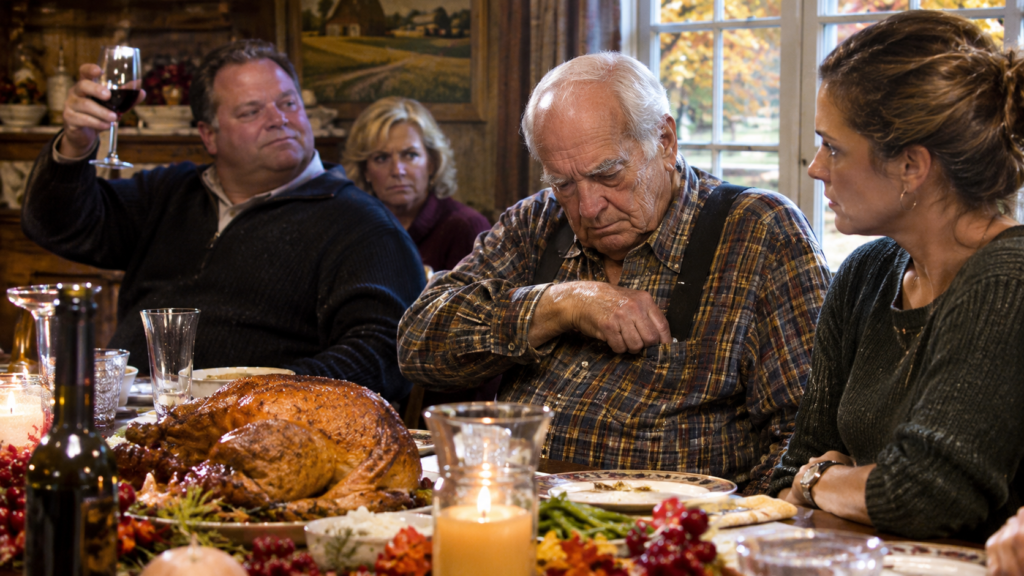
Mark stared down at his boots while Alicia placed the manila folder beside the butter dish and patted Dorothy’s hand, launching into a gentle speech about how exhausting it must be to manage a two-story house and steep stairs alone at her age. Dorothy nodded sympathetically, agreeing that stairs certainly weren’t getting any easier. Visibly relieved, Alicia flipped open the folder, clicked her pen, and slid a durable power-of-attorney and property-transfer packet across the table, assuring Dorothy she didn’t need to strain her eyes reading the dense legal paragraphs.
Before Alicia could press the pen into Dorothy’s fingers, the front doorbell rang again.
Alicia frowned, glancing toward the foyer. “Were you expecting someone else today?”
“Oh,” Dorothy replied lightly, rising from her chair. “Didn’t I mention?”
When Dorothy swung the front door open, Alicia’s composure vanished completely. Stepping into the kitchen in a charcoal suit, carrying a thick leather briefcase of his own, was Arthur Vance—accompanied by a county notary public.
“Morning, folks,” Arthur said pleasantly, taking the fourth chair at the table and setting a certified copy of Dorothy’s revocable living trust squarely on top of Alicia’s manila folder. “Dorothy called me at seven-forty this morning after hearing your entire road trip over an open phone line. I thought I’d save everyone a trip downtown.”
Mark’s face went pale as he looked from the attorney to his mother. “Mom… what is this? Alicia didn’t mean—”
“I wrote down the timestamps, Mark,” Dorothy said quietly, sliding her yellow grocery notepad next to the banana bread. “Seven-nineteen, taking my glasses so I couldn’t read the deed. Seven-twenty-six, listing my house with Bruce for a hundred and eighty thousand to pay for your boat. Seven-thirty-one, asking if you could manage to look sad.”
Alicia stammered, reaching abruptly for her folder to pull it back. “That was a private conversation! You had no right to eavesdrop—”
“You dialed her phone, Mrs. Miller,” Arthur interrupted calmly, opening his briefcase. “And even if Dorothy had signed your paperwork today, it wouldn’t have transferred a single shingle. Three years ago, Dorothy placed this residence into an irrevocable asset-protection trust naming her two grandchildren as sole remainder beneficiaries upon her passing—with this firm serving as independent co-trustee. Neither Mark nor anyone else has legal authority to encumber or list this property.”
Arthur then pulled a second sheet from his file—a formal demand notice and promissory ledger. “Furthermore, since you mentioned to your husband that the forty-thousand-dollar down payment Dorothy gave you in 2022 was somehow connected to this house, Dorothy has instructed me to formalize that disbursement as an interest-bearing loan secured against your own residence unless you vacate this driveway within five minutes and cease all unauthorized contact with her financial or medical providers.”
Alicia stared at the promissory notice, speechless for the first time since 7:15 that morning. Beside her, Mark couldn’t even lift his eyes from the table. Within two minutes, they had gathered their folder, hurried past Eleanor’s watchful kitchen window, and backed out of the driveway without touching a single slice of banana bread.
Later that afternoon, Eleanor came over with a fresh pot of coffee, and the two women sat at the oak table laughing over the timestamped grocery list—while Dorothy’s reading glasses rested right beside her teacup, untouched and crystal clear.
Editorial Note: While inspired by real-life family dynamics and elder-law protections, this story is a work of creative fiction written for entertainment purposes. Names, characters, and specific events have been dramatized.