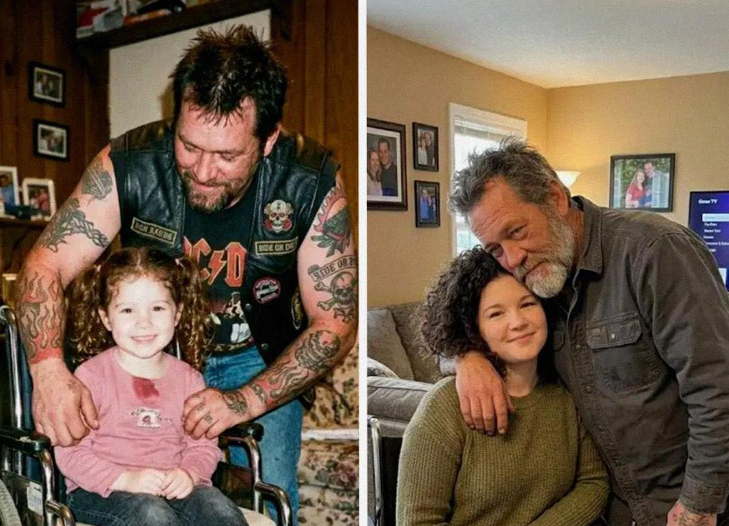
When my father died, it felt as though every conclusion about our relationship had already been carved into stone. My sister received the family home, and I was left with nothing more than harsh remarks and an old, worn-out couch that looked ready to fall apart.
That night, sitting alone with grief pressing heavy on my chest, I decided to send the couch to a repair shop. I believed it was the last useless reminder of a lifetime spent believing I never quite earned his approval. What I did not know was that the couch held something hidden deep inside its cushions — something he had carried in silence for years, something that would shift everything I thought I understood about him and about myself.
A few days later, the repairman called, his voice tight with urgency. When I arrived, he showed me a narrow, concealed compartment built into the couch’s frame. Inside it were several envelopes, a small tin wrapped in a faded cloth, and a notebook with edges softened from age.
The handwriting inside was familiar in an instant — sharp strokes mixed with uneven loops, the style my father used whenever he wrote quick notes or tucked reminders into drawers. As I turned the pages, I stepped into a part of him he never revealed while he was alive.
The notebook held entries filled with quiet admissions. He wrote about fears he kept hidden from everyone, regrets he carried heavily, and emotions he never trusted himself to speak aloud. There were sections about my childhood, my first heartbreak, and moments where he wished he had been more gentle.
One entry described my divorce with unexpected tenderness, reflecting a father who worried deeply about my emotional well-being. He wrote that he knew I often pretended to be stronger than I felt and that he struggled to find words that could support me without sounding clumsy or intrusive.
Among the pages, I found envelopes containing small amounts of money — carefully saved, labeled with dates, and meant for me.
The final note explained why the couch had been specifically set aside in his will. He wrote that he believed I was the one who needed encouragement the most, not because he saw me as weak, but because he recognized the weight I carried quietly through the years. He expressed admiration for my perseverance, my independence, and my ability to continue forward through experiences that might have broken someone else.
Walking out of the repair shop, I felt a sense of relief settle into my heart. My sister still had the house, but I held something far more meaningful than square footage or property value.
What I carried were answers to questions I had lived with for years, and proof that love often exists beneath layers of silence, waiting for the right moment to be understood. I used part of the money to settle into a small apartment that felt warm and peaceful, and I donated the rest to a local shelter, hoping it might give someone else the chance to reshape their future.
Now, every evening when I sit on the restored couch, I feel the presence of what my father had been trying to say all along. I see a man who loved deeply but spoke softly, a man who struggled to show affection yet tried in the ways he understood.
That piece of furniture no longer feels like a symbol of what I did not receive. Instead, it carries his final message — that care can be quiet, that love can be hidden in unexpected corners, and that sometimes the truth waits patiently until you are ready to find it.