Pensacola Bay’s Funny Little Finds: The “Sea Turd” Explained
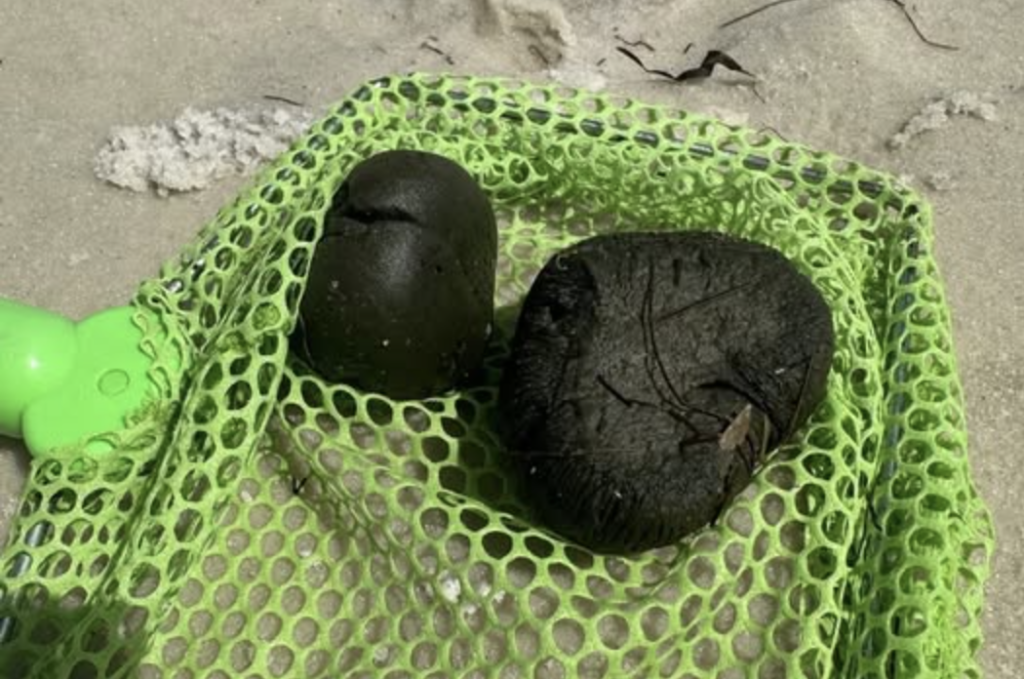
If you have ever spent time along Pensacola Bay with children, chances are you have heard joyful laughter followed by dramatic announcements. “Look what I found. A sea turd.” The phrase alone is enough to make adults laugh, even before they see what is being proudly presented. These odd little objects, while comically named, are a genuine coastal feature known as mudballs. They are a familiar sight for locals and visitors, and they tell a quiet story about how the bay continuously reshapes its shoreline.
Mudballs appear most often along shallow stretches of the bay, especially near sandy flats, marsh edges, and grassy shallows where the bottom is made of soft, clay-rich sediment. At first glance, they can look unusual or even questionable. Yet they are a normal part of the environment, resting among shells, driftwood, and sea grass until someone curious stoops to investigate.
Despite the nickname, mudballs are not manmade and they are not waste produced by marine animals. They form naturally through movement and time. The floor of Pensacola Bay contains fine mud blended with organic material from decaying plants, algae, and microscopic organisms. Waves, tides, boat wakes, storms, and even people walking in shallow water can loosen small chunks of this soft sediment.
Once a piece separates from the seabed, the water begins to shape it. Currents and gentle waves roll the fragment along the bottom, slowly smoothing it. Sand and silt act like natural polishing tools. Sharp corners soften. Jagged edges round away. Over time, the irregular clump becomes a compact, ball-shaped form. The process mirrors how river stones become pebbles or how sea glass gains its smooth surface through constant motion.
The finished mudball often feels firm yet slightly pliable, similar to dense modeling clay. Its color can range from dark green to charcoal or nearly black, depending on how much organic matter it contains. This darker shade sometimes causes concern, with people wondering if it might be oil or tar. In most cases, it is neither. It is nutrient-rich bay mud, shaped entirely by natural forces.
Mudballs typically have little to no smell and do not leave residue on the skin. If one feels sticky, smells strong, or leaves an oily film, it should be left alone and hands should be washed. Typical Pensacola Bay mudballs, however, are harmless to touch and safe to examine before being returned to the shore.
Seasonal changes influence when mudballs are most visible. After storms or periods of increased wave activity, more sediment becomes dislodged, increasing the number that wash into shallow areas. Tides also play a role, sometimes revealing clusters of mudballs during low water that remain hidden at other times. Their appearance offers subtle clues about recent weather and water movement.
Mudballs also serve a quiet ecological purpose. As they form and break down, they redistribute nutrients along the shoreline. Over time, they dissolve back into the bay, contributing organic material that supports marsh plants and microorganisms. In this way, they are part of the bay’s ongoing cycle of erosion and renewal.
For many Gulf Coast families, discovering mudballs becomes a small tradition. Children line them up on the sand, compare sizes, and carry them like prized treasures. Without realizing it, they begin learning about tides, sediment, and the steady influence of water on land. These moments often spark questions, curiosity, and early connections to nature.
Years later, long after the shells have been lost and shoes cleaned of sand, memories of the day someone found the largest “sea turd” still bring laughter. Mudballs may never headline travel guides, yet they hold a meaningful place in coastal life. They show that learning often begins with play and that even the most unexpected objects can become part of cherished family stories.
So when a child runs up holding a muddy discovery from Pensacola Bay, there is no mystery left. It is a mudball, patiently shaped by the bay itself, waiting to become part of another shoreline memory.