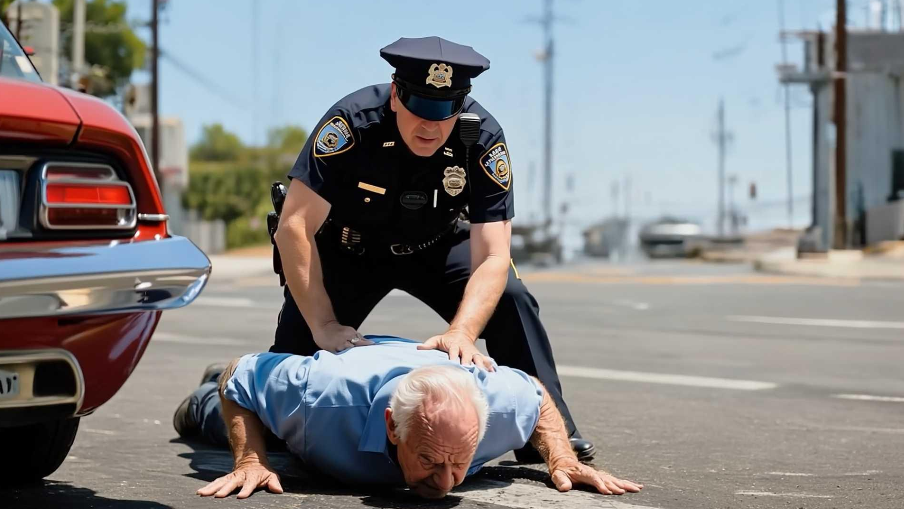
The morning unfolded like countless others for Harold, a 72-year-old veteran with a Bronze Star and two Vietnam tours etched into his history. He set out on his motorcycle for a routine VA hospital visit, the familiar rumble of his bike cutting through the warm air. But on that 97-degree day, a young officer, Kowalski, forced Harold to lie face-down on the searing asphalt, his arthritic knees pressed against the pavement, while four squad cars halted traffic for what was deemed a “standard procedure.”
For twenty-three minutes, Harold endured the indignity, his gray beard scraping the road, hands bound behind his back, as curious drivers slowed to stare at the “threatening biker” in custody. A passerby’s voice carried, instructing her children to “see the criminal,” unaware that the man baking on the concrete was a decorated hero whose motorcycle pipes—recently inspected and approved—had sparked this ordeal for being “too loud.”
Officer Kowalski stood over Harold, his boot hovering near the veteran’s head, occasionally prodding when Harold shifted to ease the pain in his knees. “Stay down, old man,” Kowalski declared loudly, ensuring the growing crowd heard. “These old bikers act like they rule the roads. Time to set them straight.”
When they finally allowed Harold to rise, his face bore the red marks of scorched asphalt, his hands trembling as he fought to preserve his dignity. Away from the dash cams, Kowalski leaned close and whispered words that shattered the resolve of a man married to his wife, Nancy, for 48 years.
Later, when Nancy pressed him, Harold’s gaze fixed on the wall. “He said guys like me don’t belong on the roads anymore. Said it’s time to retire before someone gets hurt.”
Nancy, however, refused to let this stand. Her next steps would either fracture their marriage or restore her husband’s spirit. She faced a choice: remain the compliant spouse others expected or embrace the fierce woman she’d always been.
Nancy’s Fight: A Wife’s Mission to Defend Her Husband
I’m Nancy, and I must share what they did to my Harold. Not for sympathy, nor to pursue a lawsuit—Harold would never be that person. I speak because that day broke something in the strongest man I know, and I refuse to let it define him.
Harold isn’t a hobbyist who picked up biking late in life. He’s ridden since age sixteen, taught by his father, a Korean War veteran, on an old Indian motorcycle. He rode through Vietnam, delivering messages through hostile territory, saving lives with his skill. He rode to our wedding, to the hospital for the births of our three children, and to the funeral of our son, lost in Afghanistan.
That motorcycle in our garage is more than metal. It’s Harold’s link to every mile, every storm, every comrade he’s outlived. Yet a young officer with minimal experience tried to strip that away with a few cruel words.
The day started ordinarily. Harold rode to the VA for a routine checkup, his liver enzymes monitored due to Agent Orange exposure. He always rides when the weather permits, claiming the breeze clears the haze of his medications.
Sirens wailed near our home, a common sound near the main road, so I thought little of it. But when Harold didn’t return after two hours, worry set in. His appointments are never lengthy.
Then our neighbor, Janet, arrived, her face ashen, clutching her phone. “Nancy, you need to see this,” she said, showing a video her son had recorded.
There was Harold, encircled by police cars, lying face-down on blistering asphalt. His bike stood askew, as if stopped abruptly. Four officers loomed, hands on their holsters, one pressing a knee into Harold’s back.
My hands trembled watching my husband—a man who raised three children, buried one, earned a Bronze Star, and never had a traffic violation in fifty years—treated like a felon.
“It was filmed forty minutes ago,” Janet whispered. “The kids are sharing it online, calling it police brutality.”
I grabbed my keys and sped to the scene. By the time I arrived, Harold sat on the curb, no longer cuffed but still surrounded. His face was flushed from heat and effort, sweat drenching his vest adorned with military patches and a “22 a Day” ribbon for veteran suicide awareness.
“Ma’am, stay back,” an officer warned as I approached.
“That’s my husband,” I retorted, pushing forward. “Harold, are you okay?”
He looked up, his eyes carrying shame, pain, and defeat—a look I’d never seen. “I’m fine, Nan,” he said, his voice uncharacteristically soft.
“What happened? Why—”
“His exhaust violates decibel limits,” Officer Kowalski cut in, badge number 4782. “We had multiple complaints.”
“From who?” I demanded. “He rides this route monthly. No one’s ever complained.”
Kowalski shrugged. “Anonymous tips. Three this morning.”
I understood immediately. Harold had recently spoken at a city council meeting against a proposed motorcycle noise ordinance, a move to deter bikers from certain roads. He’d been compelling, highlighting how riding aids veterans’ mental health and how bikers support local charities. He’d also humiliated the mayor’s son, who championed the ordinance after buying a home on Main Street.
“So you threw a 72-year-old veteran on the ground for loud pipes?” I asked, my voice sharp. “Pipes that passed inspection two weeks ago?”
“He didn’t comply immediately,” Kowalski replied mechanically. “We followed protocol.”
“He’s partially deaf from the war!” I countered. “It’s in his VA file. He might not have heard you clearly.”
The officers exchanged uneasy looks. They hadn’t known. They saw an older biker and made snap judgments.
After an hour of “processing”—mostly standing and radio chatter—they released Harold with a verbal warning, no ticket. The same exhaust, inspected fourteen days prior, was suddenly a problem.
Harold was silent on the drive home, his bike trailing behind. In the rearview mirror, I noticed his cautious riding, as if fearing attention.
That evening, after a shower and a meal he barely ate, I found him in the garage, staring at his bike.
“Want to talk?” I asked, sitting beside him.
After a long silence, he spoke. “Kowalski. After they let me up, after you went to get the car… he pulled me aside.”
“What did he say?”
Harold’s hands tightened. “Said guys like me don’t belong on the roads. Said it’s time to retire before someone gets hurt. Said next time…” He stopped.
“Next time what?”
“They’d find something that sticks. Said there’s always something if they look hard enough.”
The threat lingered, heavy and real. We both knew the implication: fabricate a violation, make riding impossible.
“You can’t let them win,” I said. “This is who you are.”
“Maybe he’s right,” Harold replied, his words a gut punch. “Maybe I’m too old. Maybe it’s time.”
“Harold Eugene Mitchell,” I said firmly. “You’ve ridden for fifty-six years, survived Vietnam, Agent Orange, cancer, and losing Bobby. You’ll let a rookie cop tell you who you are?”
He almost smiled. Almost.
Over the next days, Harold withdrew. He skipped his veterans’ group ride, canceled leading the Memorial Day ride, and left his bike untouched, dust settling on it for the first time.
But I acted. I called Janet’s son, other witnesses, Harold’s riding buddies, and my nephew, a civil rights attorney. I learned Harold wasn’t alone. Seven other older bikers, all vocal at the council meeting, had faced similar harassment. Two had sold their bikes.
This wasn’t about noise. It was about image. The mayor’s son and his developer allies wanted a sanitized town, excluding those who didn’t fit their vision.
They underestimated me.
I organized discreetly—coffee with wives, chats at the store. Within a week, I had a network of furious women whose husbands were targeted. By the second week, we had a strategy.
The night before the next council meeting, I told Harold I was running errands. Instead, I met Dr. Patricia Reeves, head of psychiatric services at the VA hospital.
“Mrs. Mitchell,” she greeted. “How can I help?”
I recounted the incident, Harold’s withdrawal, the threat. Her expression hardened.
“Do you know how many veterans rely on motorcycling for therapy?” she said. “What they did to your husband is unacceptable.”
“Will you speak at the council meeting?” I asked. “They need an expert’s voice.”
“I’ll do more,” she replied. “I’ll bring data, statistics, and others who want to speak.”
The morning of the meeting, Harold noticed my attire. “Going somewhere special?” he asked.
“City council meeting,” I said lightly. “Want to come?”
He declined. “I’m done with that fight, Nan.”
“That’s okay,” I said, kissing him. “I’m not.”
Harold didn’t know his riding group, their wives, Dr. Reeves, VA representatives, my nephew with legal documents, and Janet’s son with his edited video would be there.
The council chamber overflowed with leather vests, military patches, and resolute faces. When the mayor’s son rose to pitch his expanded noise ordinance, he hesitated, seeing the crowd.
I spoke first, nerves steadying my voice. “I’m Nancy Mitchell. My husband Harold has served this community for forty years, volunteering at charity rides, raising funds for the children’s hospital, mentoring veterans with PTSD. Two weeks ago, your police forced him face-down on scorching asphalt for riding while old.”
I displayed the video. “I have footage, seven other riders with similar stories, and a question: Is this how you treat veterans? That their service means nothing if they ride motorcycles?”
Others followed. Dr. Reeves shared data on motorcycling’s therapeutic benefits. Veterans recounted how riding saved them. My nephew outlined potential lawsuits.
Then 85-year-old Walter “Tank” Morrison, a Korean War veteran with no legs below the knees, stood. “I was born here,” he said. “Fought for this country, built a life here. Now you say I can’t ride because it bothers newcomers? You let your cops threaten men like Harold Mitchell, good men who’ve given everything?”
He steadied himself. “We were here first. We’ll be here when you’re gone. We’ll ride until we choose to stop, not because some overzealous rookie thinks harassment is policing.”
The room roared with applause. The mayor called for order, but the momentum had shifted. News crews, tipped off by Janet’s son, captured it all.
During a recess, Kowalski approached me, out of uniform, looking uneasy. “Mrs. Mitchell, I owe you and your husband an apology. My supervisor said these bikers were trouble. I didn’t think about who they were.”
“You told my husband he didn’t belong,” I said. “He earned a Bronze Star, rode 500,000 miles without an accident. He knows more about road safety than you ever will. Next time you see an old biker, remember that.”
When the meeting resumed, the mayor withdrew the ordinance for “further review” and announced police training on engaging with veterans and elderly residents.
It was a victory, but I worried about Harold’s reaction. I hadn’t told him.
At home, I found him in the garage, not staring but working on his bike, changing the oil—the first maintenance since the incident.
“Heard there was a big turnout at the council,” he said, not looking up. “Seems someone rallied the riding community.”
“Oh?” I said, feigning innocence. “That’s nice.”
He laughed, the first real laugh in weeks. “Tank called. Said my wife was like a drill sergeant. Dr. Reeves called too. Walter’s son showed me the video.”
He hugged me, oil-stained hands and all. “Thank you.”
“I couldn’t let them win,” I said. “You’ve earned every mile, Harold.”
“Kowalski left a message,” he said. “Wants to apologize.”
“What will you do?”
“Might invite him for a ride. Show him what real motorcycling is. He needs to learn, not be punished.”
That was Harold—always teaching, never vengeful.
“Still riding?” I asked.
He looked at his bike. “Had a moment of doubt. Let that cop in my head. But these roads know me. Every mile’s a memory. This bike and I have too much history to let small-minded people decide when we’re done.”
The next morning, his bike roared to life. From the window, I saw him gear up and pull out, giving the throttle a slight twist—enough to declare his return.
That week, his riding group visited, presenting a “Too Tough to Stop” patch. Tank spoke of brotherhood, leaving no dry eyes.
Kowalski came by Sunday, apologizing sincerely. Harold accepted, and they talked for hours about bikes, service, and assumptions. Harold agreed to help train officers on engaging with bikers.
Six months later, Harold led the Memorial Day ride, 500 riders in formation. Kowalski joined the police escort, now trained in motorcycle safety.
The mayor’s son moved away. The ordinance faded. Harold rides whenever he can, his beard dancing in the wind, eyes bright.
Sometimes I find him in the garage, sitting with his bike in quiet companionship. It’s no longer a symbol of defeat but of freedom and resilience.
They tried to convince him he didn’t belong. They failed. Men like Harold, who’ve sacrificed so much, don’t surrender easily. With support, they rise stronger.
And if anyone tries again? They’ll face wives like me. We’re tougher than we seem.
The roads belong to those who’ve earned them through grit and heart. Harold earned his decades ago. No harassment or threats will change that.
He rides because it’s who he is. And who he is, is exactly who he should be.