For forty-four years, Christmas Eve supper in our house meant one thing: driving three miles out on Highway 61 to the Branding Iron steakhouse, sliding into the corner vinyl booth beside the twelve-foot Douglas fir, and ordering two cuts of slow-roasted prime rib with loaded baked potatoes. The waitresses knew our order before we even unfolded our paper napkins, and back in 1983, Merritt had carried our daughter, Jolynn, through those heavy timber doors in a plastic infant carrier while snow blew sideways across the gravel lot.
So when the postcard mailer arrived during the second week of December advertising the Branding Iron’s annual Christmas Eve Prime Rib for Two at ninety dollars, I pinned it right beneath the magnet from our grandkids’ elementary school in Kansas City and drew a neat red circle around the price. That Saturday afternoon, I drove into Hannibal, found a dark green velvet dress on the clearance rack at JCPenney for thirty-four dollars—the first new dress I had bought myself in three years—and hung it in the back of the closet behind my winter coats.
After thirty-one years standing on concrete floors at the shoe factory, my pension covers our homeowners insurance, the electric bill, and the property taxes on our clapboard house. Merritt retired from the rail yard nine years ago, and he has always kept a tight fist around the checking account, handing me sixty dollars in cash every Monday morning for groceries and checking the itemized slip when I get back from the store. I never complained or kept a ledger between us. In my mind, forty-four years of marriage meant one household.
On Monday morning, Merritt walked into the kitchen in his flannel bathrobe, poured his coffee, and pulled the red-circled postcard straight off the refrigerator door. Holding it between two fingers as if it were an overdue utility notice, he informed me that ninety dollars for two slices of beef was out of the question because his pickup needed new front tires before January. He folded the mailer twice, tucked it into his shirt pocket, and reminded me that we weren’t made of money.
I swallowed hard, told him softly that it was fine, and waited until the garage door rattled shut behind him before walking down the hall to the bedroom. I sat on the edge of the mattress for twenty minutes, staring at the price tag still dangling from the sleeve of that green velvet dress, realizing it wasn’t the prime rib that hurt—it was the tone he used, as though I had asked him to buy me a mink coat.
Four hours later, the landline on the kitchen wall rang. When I picked up the receiver, a bright, cheerful hostess from the Branding Iron asked to confirm Mr. Ashworth’s Christmas Eve reservation for seven o’clock—specifically noting his request for the corner booth by the Christmas tree, a lit table candle, and seating for three.
My fingers tightened around the white counter edge until my knuckles turned pale. Calmly, I thanked the girl, confirmed that the table for three was still correct, and hung up the phone. Sitting down at the table, my gaze fell on the blue plastic pill organizer beside the sugar bowl—specifically on the little square marked T. For thirty years, every single Tuesday evening and every second Saturday afternoon, Merritt had driven forty miles south toward Bowling Green for what he called his rail-union retirees’ committee meetings. Thirty years of Tuesdays, and I had never once questioned the mileage on his odometer.
That evening over meatloaf, Merritt announced that he wouldn’t be home for supper on Christmas Eve because he needed to drive a spiral-cut ham over to his older brother, Alvis, who lived alone across the county line. I smiled, told him how thoughtful that was, and spent the next six days ironing his good collars, wrapping his flannel shirts under the tree, and chatting cheerfully with Jolynn on the phone so she wouldn’t hear a tremor in my voice. Every night, lying awake beside him in the dark, I tried to convince myself he was simply treating an old rail-yard buddy and his wife, or a lonely widow from the senior center.
On Christmas Eve at half past six, Merritt stepped out of the bathroom wearing his pressed brown tweed jacket and the sandalwood cologne I had given him the previous autumn. Before he slipped his hand into his coat pocket, I caught the unmistakable glint of a small, velvet-wrapped jewelry box. He kissed my cheek, promised he wouldn’t be late, and backed down the driveway.
Ten minutes after his taillights disappeared around the bend, I walked into the bedroom, snipped the paper tag off my thirty-four-dollar green velvet dress, fastened my mother’s pearl clip-on earrings, and drove out to the highway.
Inside the Branding Iron, woodsmoke and roasting beef hung warm in the air. I took the last vinyl stool at the far end of the polished oak bar—the one angled directly toward the corner booth beside the tree—and ordered a fountain Coke from a bartender wearing a sequined Santa hat. A single white pillar candle was already flickering on our table. And sitting on the far side of the booth was a broad-shouldered man in his early thirties wearing a navy crewneck sweater, glancing repeatedly at his wristwatch.
At five minutes past seven, the front door swung open, letting in a gust of freezing December air. Merritt walked into the lobby with a woman around sixty dressed in a tailored red wool coat, her gloved hand tucked securely through the crook of his arm as both of them laughed. I watched my husband step behind her, lift the red coat carefully off her shoulders, and drape it over his arm—something he hadn’t done for me since Ronald Reagan was in the White House.
The hostess led them straight past the bar without Merritt ever turning his head an inch toward my stool. When they reached the corner booth, the young man in the navy sweater stood up immediately, reached across the table to pull my husband into a tight, familiar embrace, and spoke loud enough to carry clearly over the clinking silverware:
“Happy Christmas Eve, Dad—Mom’s been dying to give you your present before dinner gets here.”
For three seconds, the hum of the dining room seemed to vanish entirely. Sitting on my barstool with my cold glass untouched, I watched Merritt beam with pride, drape an arm around the young man’s shoulders, and reach into his brown tweed coat pocket for the small velvet jewelry box—not for a widow from the senior center, and not for his brother Alvis, but for the second family he had been funding every Tuesday night for thirty years while counting out sixty dollars a week for my grocery receipts.
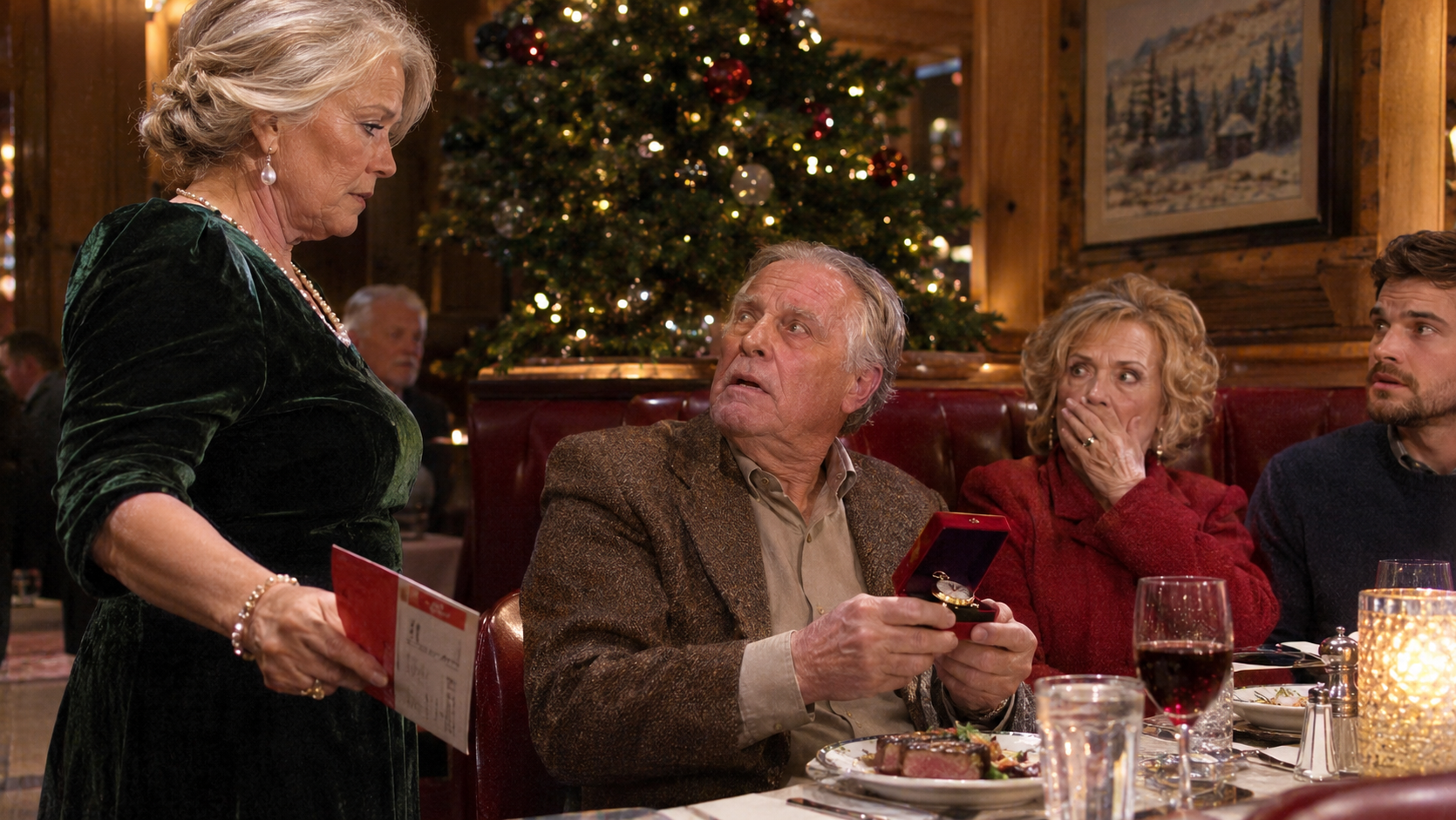
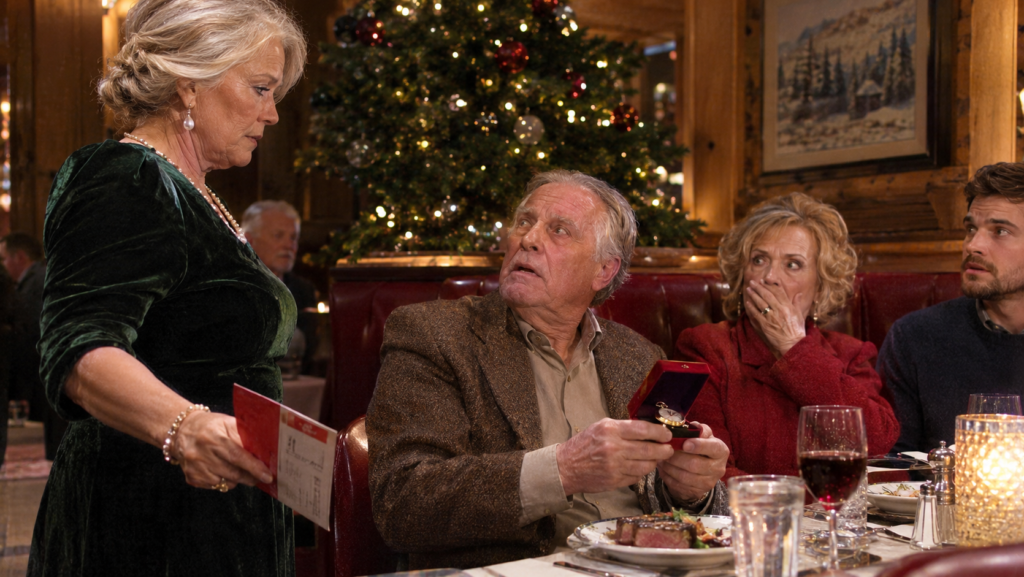
I didn’t scream, and I didn’t throw a glass across the dining room. Instead, I set two one-dollar bills beside my napkin on the bar, walked calmly across the carpeted floor, and stopped directly beside the corner booth just as Merritt snapped open the velvet box to reveal a gold-plated lapel watch.
“Well, Merritt,” I said, resting one hand lightly on the back of the booth so every person at the neighboring tables could hear. “I’m glad to see the pickup tires can wait until spring after all.”
Merritt’s jaw went slack, the color draining so fast from his cheeks that the candle flame looked brighter than his face. The woman in the red coat froze with her water glass halfway to her lips, looking from my green velvet dress to Merritt’s trembling hands. “Clara? What—what are you doing here?”
“I came to return the ninety dollars you saved on my supper,” I said evenly, laying the red-circled postcard mailer he had taken off our refrigerator right beside the lit candle. “And to introduce myself to your Tuesday-night union committee. Hello—I’m Clara Ashworth. Merritt and I have been married forty-four years, and my shoe-factory pension has been paying the property taxes and electric bills on our house so he could afford to buy his other family prime rib.”
The young man in the navy sweater looked at Merritt in shock, slowly lowering his hands to the tabletop. “Dad… you told us you and Aunt Clara divorced back in ninety-two.”
“He lied to both of us, son,” I replied, looking straight at the woman in the red coat, whose eyes had widened in horror as the truth settled over the table. “Enjoy your dinner. By the time Merritt gets back to our driveway tonight, every lock on the front door will be changed, and my attorney will be drafting the paperwork to put our house on the market first thing Monday morning.”
I turned and walked out of the Branding Iron into the crisp winter night without looking back once—leaving Merritt stammering helplessly under the Christmas lights in front of two families who finally knew exactly what kind of man he was.
Editorial Note: While inspired by real-life family betrayals and long-term secret lives, this story is a work of creative fiction written for entertainment purposes. Names, characters, and specific events have been dramatized.